From a free demo to 365 days of updates and a clearly stated refund policy, TorrentExam covers every step of your SOA Cloud Architecture Lab preparation in one place. Thousands of candidates in 2026 start their C90.06 journey right here.
SOA C90.06 Exam Overview:
| Certification Vendor: | SOA School of Architecture (Arcitura Education) |
|---|---|
| Exam Name: | Cloud Architecture Lab |
| Exam Number: | C90.06 |
| Certificate Validity Period: | Lifetime |
| Available Languages: | English |
| Real Exam Qty: | 15 |
| Related Certifications: | Fundamental Cloud Computing (C90.01) Advanced Cloud Architecture (C90.05) Cloud Technology Concepts (C90.02) Certified Cloud Architect Cloud Technology Lab (C90.03) |
| Exam Price: | USD $250 |
| Passing Score: | 70% |
| Exam Format: | Scenario-Based Questions, Architecture Analysis, Lab-Based Exam, Case Study |
| Exam Duration: | 90-120 |
| Sample Questions: |  |
| Exam Way: | Online proctored exam delivered through Arcitura Education authorized testing platform. |
| Pre Condition: | Recommended: Completion of C90.01, C90.02, C90.03 and C90.05 or equivalent knowledge and experience. |
| Official Syllabus URL: | https://www.arcitura.com/cloudarchitect |
SOA C90.06 Exam Syllabus Topics:
| Section | Weight | Objectives |
|---|---|---|
| Cloud Architecture Lab Scenarios | 20% | - Hands-On Architecture Analysis
|
| Cloud Computing Fundamentals Application | 15% | - Application of Fundamental Cloud Concepts
|
| Advanced Cloud Architecture | 25% | - Advanced Architectural Patterns
|
| Fundamental Cloud Architecture | 20% | - Architectural Design Practices
|
| Cloud Technology Implementation | 20% | - Cloud Technology Usage
|
SOA C90.06 Exam: Frequently Asked Questions
The SOA Cloud Architecture Lab exam is the official SOA School of Architecture (Arcitura Education) test registered under exam code C90.06. Passing it earns you the SOA Certification certification, a credential at the Professional level. It is also linked to the related certifications: Certified Cloud Architect, Advanced Cloud Architecture (C90.05), Fundamental Cloud Computing (C90.01), Cloud Technology Concepts (C90.02), Cloud Technology Lab (C90.03). SOA School of Architecture (Arcitura Education) exams are valued because they test job-ready skills, so a passing score here carries real weight on a resume.
The SOA Cloud Architecture Lab exam includes 15 questions to be completed within 90-120. Do the pacing math before exam day: with that many items on the clock, you need a steady rhythm and the discipline to flag a hard question and move on instead of stalling. Two or three full timed sessions with the TorrentExam test engine will show you exactly what that pace feels like, so time pressure stops being a factor on the real day.
To pass the SOA Cloud Architecture Lab exam you need 70%, and the official registration fee is USD $250. A retake is not discounted: a failed attempt means paying the full USD $250 again, so treat your first sitting as the expensive one. A sensible rule is to book your seat only after you are scoring comfortably above the passing mark on the TorrentExam practice tests, not just squeaking past it once.
Recommended: Completion of C90.01, C90.02, C90.03 and C90.05 or equivalent knowledge and experience.
Eligibility rules do change from time to time, so confirm the current requirements before you register on the official exam page.
Yes. TorrentExam offers a free PDF demo of the SOA Cloud Architecture Lab material so you can judge the question quality and format before spending anything. After purchase, your license includes 365 days of free updates, and if you want to keep receiving updates after that period, renewals are available at a 50% discount.
If you take the SOA Cloud Architecture Lab exam within 60 days of your purchase and do not pass, TorrentExam backs you with a 100% money-back guarantee. The claim must match the exam your product covers: attempts taken within 3 days of purchase are not eligible (that is too little preparation time), and neither are downloaded-but-unused products, free materials, or expired orders. The candidate name must match the payer name, and you need to submit a scanned enrollment slip plus the official Score Report PDF within 2 days of the exam; claims are processed within 7 days. Prefer not to refund? You can swap instead and receive two other exam products of equal value for free while keeping the update service on your original purchase.
Delivery itself is instant: your files are downloadable right away and emailed to you within one minute of payment. If nothing arrives within 2 hours, contact customer service. There is no limit on how many computers you may install the software on.
The official SOA Cloud Architecture Lab syllabus is organized into 5 domains. Key areas include Cloud Computing Fundamentals Application (15%), Cloud Architecture Lab Scenarios (20%), and Cloud Technology Implementation (20%). The complete, up-to-date topic list appears in the exam topics section above; work through it line by line and flag anything you cannot yet explain in your own words.
SOA Cloud Architecture Lab Sample Questions:
Physical Server A hosts Hypervisor A which hosts Virtual Server A, Virtual Server B and an active cluster comprised of three virtual servers. Virtual Server A hosts Ready-Made Environment A.
Ready-Made Environment A uses Cloud Storage Device A to store data related to the ready-made environment and its users. Cloud Service A is hosted by a high- availability (HA) virtual server cluster. Hypervisor A is a cluster-enabled hypervisor.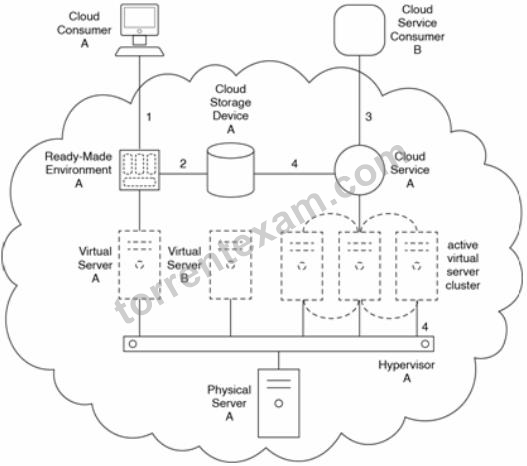
Developers access Ready-Made Environment A to work on the development of a new solution (1). During this usage. Ready-Made Environment A regularly reads and writes data to Cloud Storage Device A (2). Cloud Service Consumer B accesses Cloud Service A (3).
Cloud Service A queries data residing in Cloud Storage Device A in response to processing requests from Cloud Service Consumer B (4).
Hypervisor A is made part of a cluster of hypetvisors. Ready-Made Environment A, which is still hosted by Virtual Server Aon Hypervisor A, subsequently becomes unexpectedly unavailable. It then takes twenty minutes to pass before Virtual Server A and Ready-Made Environment A become available again on Hypervisor B (a hypervisor that is also part of the hypervisor cluster). This delay is considered unacceptable by Cloud Consumer A.
Furthermore, after being relocated to Hypervisor B, Virtual Server A is unable to connect to the network. By the time the cloud provider rectifies this second problem, Cloud Consumer A experiences a total of two hours of downtime.
Which of the following statements describes a solution that can minimize or entirely avoid a delay for the runtime relocation of Ready-Made Environment A?
- A. The Load Balanced Virtual Server Instances and Persistent Virtual Network Configuration patterns can be applied together to ensure that the virtual servers retain their network configurations when moving to another hypervisor. The Redundant Storage pattern can further be applied to move the ready-made environment to another hypervisor without service impact.
- B. The Hypervisor Clustering pattern was incorrectly applied and therefore needs to be re- applied correctly in order to establish a native system capable of instantly relocating virtual servers between hypervisors within the same cluster. The Direct I/O Access pattern can then also be applied so that the virtual servers retain their network configurations regardless of which hypervisor within the cluster they reside on.
- C. The Non-Disruptive Service Relocation pattern can be applied to place a secondary copy of Ready-Made Environment A on Hypervisor B.
The Persistent Virtual Network Configuration pattern can be applied so that virtual servers retain network configurations when moving to other hypervisors. - D. The Load Balanced Virtual Server Instances pattern can be applied in combination with the Elastic Network Capacity pattern in order to establish a system whereby Ready-Made Environment A can be smoothly transitioned between hypervisors in the same cluster, while its underlying virtual server maintains the network connection.
Correct Answer: C 🗳️
A cloud provider has two cloud environments (Cloud A and Cloud B) that are in different geographical regions. Cloud Service A resides in Cloud A.
A redundant implementation of Cloud Service A resides in Cloud B.
An automated scaling listener is used in Cloud A to automatically balance the workload of requests for Cloud Service A across the two redundant implementations. Cloud Service A is required to access Cloud Storage Device A, which also resides in Cloud A.
A redundant implementation of Cloud Storage Device A is located in Cloud B.
A failover system is used to ensure that if the Cloud Storage Device A implementation in Cloud A fails, the Cloud Storage Device A implementation in Cloud B takes its place.
Cloud Service Consumer A is owned by Organization A.
Cloud Service Consumer A sends a request to Cloud Service A (1). The automated scaling listener intercepts the request and directs it to the Cloud Service A implementation in Cloud A (2). This Cloud Service A implementation attempts to access Cloud Storage Device A in Cloud A, but Cloud Storage Device A fails (3). The failover system redirects the request to Cloud Storage Device A in Cloud B (4). Cloud Service Consumer B sends a request to Cloud Service A (5). The automated scaling listener intercepts the request and directs it to the Cloud Service A implementation in Cloud B (6). This Cloud Service A implementation accesses Cloud Storage Device A in Cloud B to fulfill the request (7).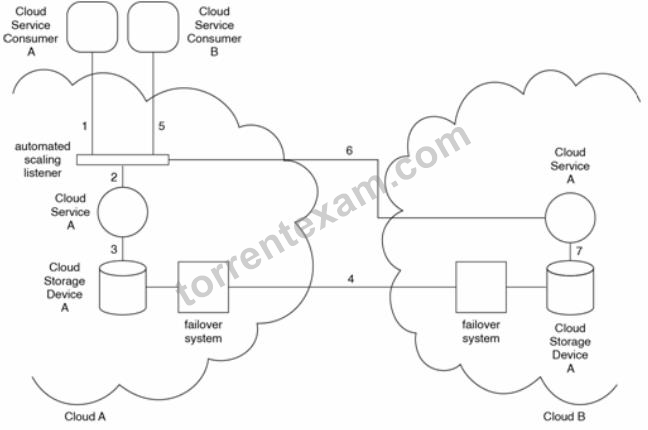
An unexpected outage occurs in Cloud A, making Cloud Service A unavailable.
Organization A notices that its cloud resource administrator can continue accessing data in Cloud Storage Device A via a usage and administration portal. Cloud Service Consumer A is unable to access data in Cloud Storage Device A via Cloud Service A during the outage.
The cloud resource administrator manually restarts Cloud Service A and it continues to function normally.
Organization A needs to change the cloud architecture so that when Cloud Service A fails, three automated attempts are made to recover it before a manual restart is required.
Due to data storage regulations, Organization A is prohibited from storing some types of data across more than one cloud storage device. A large amount of the data in Cloud Storage Device A is subject to these regulations. Because of an increase in usage, the capacity of Cloud Storage Device A has reached its limit, resulting in regular delays and lag time when processing data access requests during peak usage times.
A management change by another cloud consumer organization inadvertently reconfigures settings in the failover system used in Cloud A for Cloud Storage Device A.
Organization A complains to the cloud provider who promises to take the steps required to prevent management tasks performed by other cloud consumer organizations from affecting IT resources being used by Organization A.
Which of the following statements describes a solution that can resolve all of these issues?
- A. The Dynamic Failure Detection and Recovery pattern can be applied so that if Cloud Service A in Cloud A fails, a watchdog system attempts to automatically recover Cloud Service A.
Assuming Cloud Storage Device A has support for multiple disk types, the Intra- Storage Device Vertical Data Tiering pattern can be applied so that Cloud Storage Device A is equipped with dynamic vertical scaling. The Resource Management pattern can be applied to allow cloud consumer organizations to perform management tasks on IT resources without impacting IT resources being used by other cloud consumer organizations. - B. The Zero Downtime pattern can be applied to establish a cross-cloud failover system for the two Cloud Service A implementations. The Cross-Storage Device Vertical Tiering pattern can be applied to vertically scale data in Cloud Storage Device A across multiple other cloud storage devices dynamically. The Centralized Remote Administration pattern can be applied to establish a logical network perimeter around Organization A's IT resources, thereby protecting them from other cloud consumer organizations.
- C. The Load Balanced Virtual Server Instances pattern can be applied to balance the virtual servers hosting Cloud Service A implementations across the two cloud environments. The Storage Workload Management pattern can be applied to balance workloads across both Cloud Storage Device A implementations. The Resource Reservation pattern can be applied to establish a physical network boundary around Organization A's IT resources, thereby protecting them from other cloud consumer organizations.
- D. None of the above.
Correct Answer: A 🗳️
Viewing page 1 out of 8 pages.
Viewing questions 1-2 out of 15 questions.
 Raymond

 Malcolm

 Ziv
 Arnold

 Newman
 Noel
 April
 Iris
 Lance
 Michaelia
 Jerry
 Ingram
 Everley
 Chad
 Martin
 Abigail
 Hayden
 Diana