

Last DP-100 practice test reviews: Practice Test Microsoft dumps
Try DP-100 Free Now! Real Exam Question Answers Updated [Feb 01, 2024]
The dream of becoming a highly skilled data scientist can turn into a reality with the help of the Microsoft DP-100 exam. This exam tries to impart an associate-level understanding of data science and machine learning with an aim to generate a skilled workforce of data scientists.
Microsoft DP-100 certification exam is a highly regarded certification in the field of data science. DP-100 exam is designed to test the candidate's expertise in designing and implementing data science solutions on Microsoft Azure. Candidates who pass the exam will be able to demonstrate their ability to design and implement data science solutions on Microsoft Azure, which can open up new career opportunities in the field of data science.
NEW QUESTION # 85
You are developing a linear regression model in Azure Machine Learning Studio. You run an experiment to compare different algorithms.
The following image displays the results dataset output: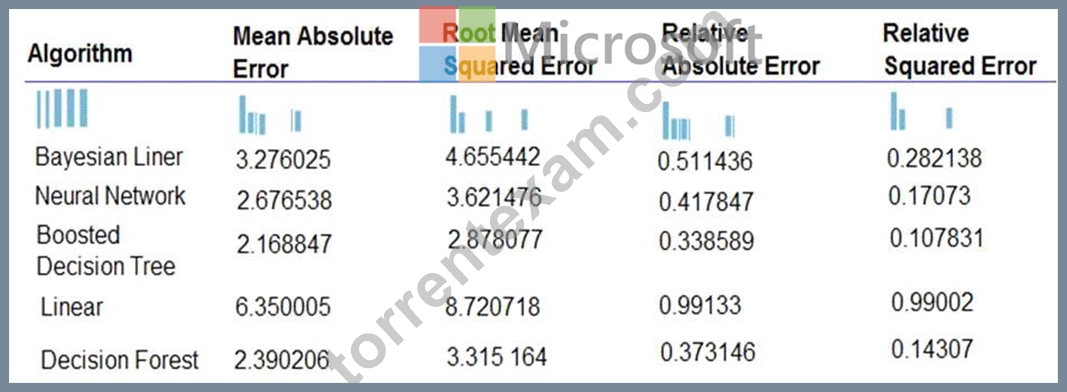
Use the drop-down menus to select the answer choice that answers each question based on the information presented in the image.
NOTE: Each correct selection is worth one point.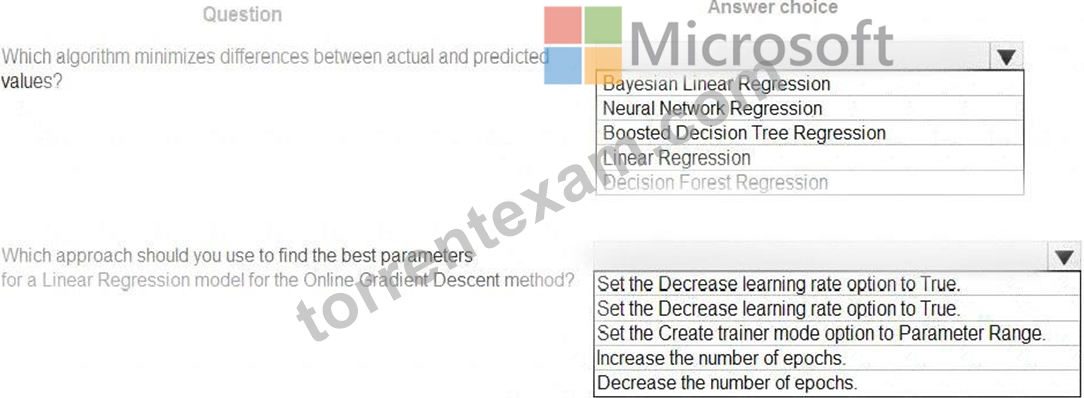
Answer:
Explanation: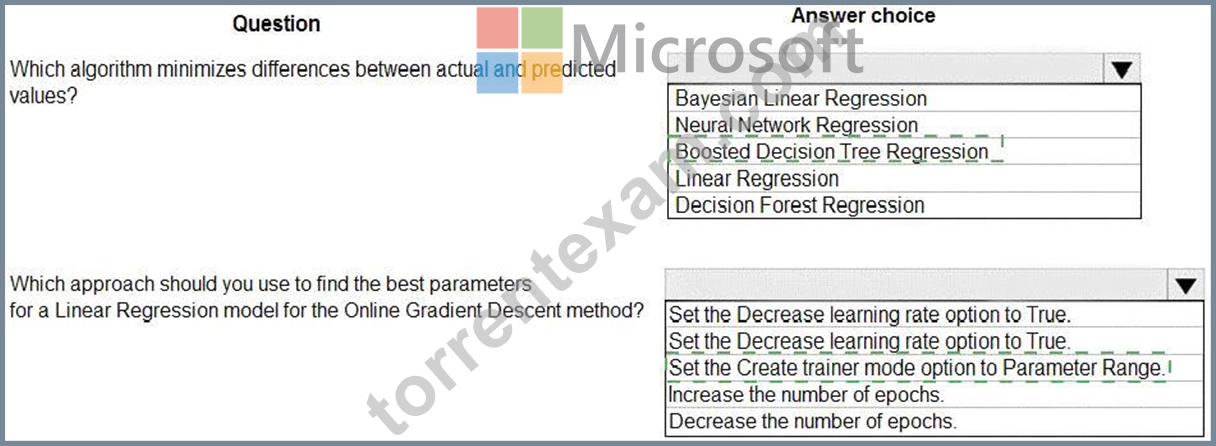
Explanation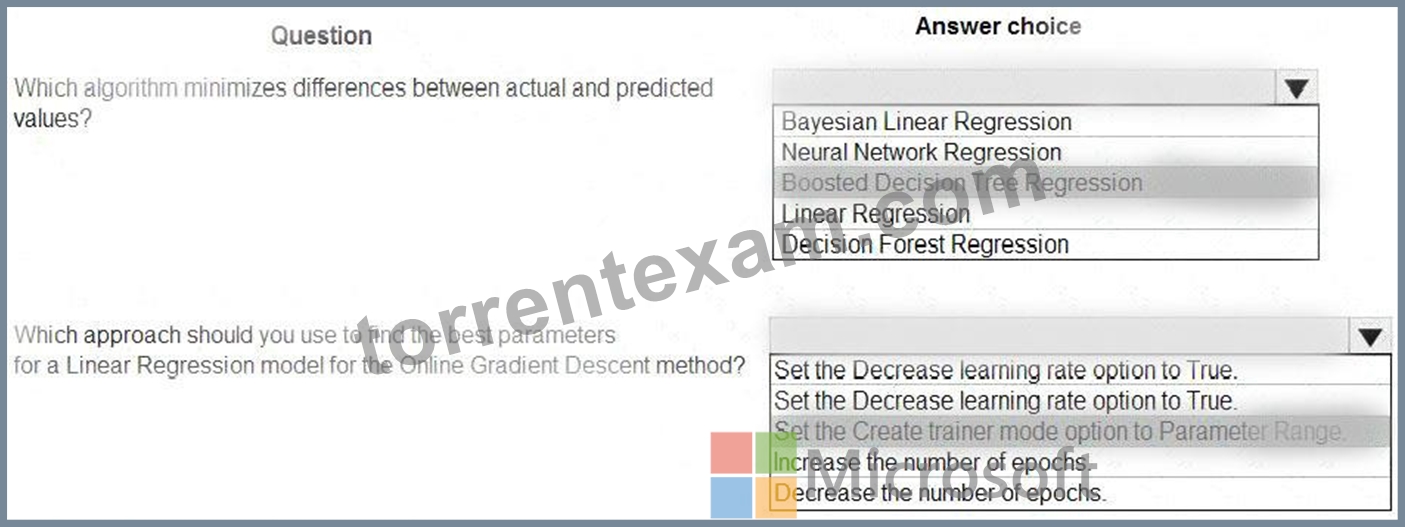
Box 1: Boosted Decision Tree Regression
Mean absolute error (MAE) measures how close the predictions are to the actual outcomes; thus, a lower score is better.
Box 2:
Online Gradient Descent: If you want the algorithm to find the best parameters for you, set Create trainer mode option to Parameter Range. You can then specify multiple values for the algorithm to try.
References:
https://docs.microsoft.com/en-us/azure/machine-learning/studio-module-reference/evaluate-model
https://docs.microsoft.com/en-us/azure/machine-learning/studio-module-reference/linear-regression
NEW QUESTION # 86
You create a multi-class image classification deep learning experiment by using the PyTorch framework. You plan to run the experiment on an Azure Compute cluster that has nodes with GPU's.
You need to define an Azure Machine Learning service pipeline to perform the monthly retraining of the image classification model. The pipeline must run with minimal cost and minimize the time required to train the model.
Which three pipeline steps should you run in sequence? To answer, move the appropriate actions from the list of actions to the answer area and arrange them in the correct order.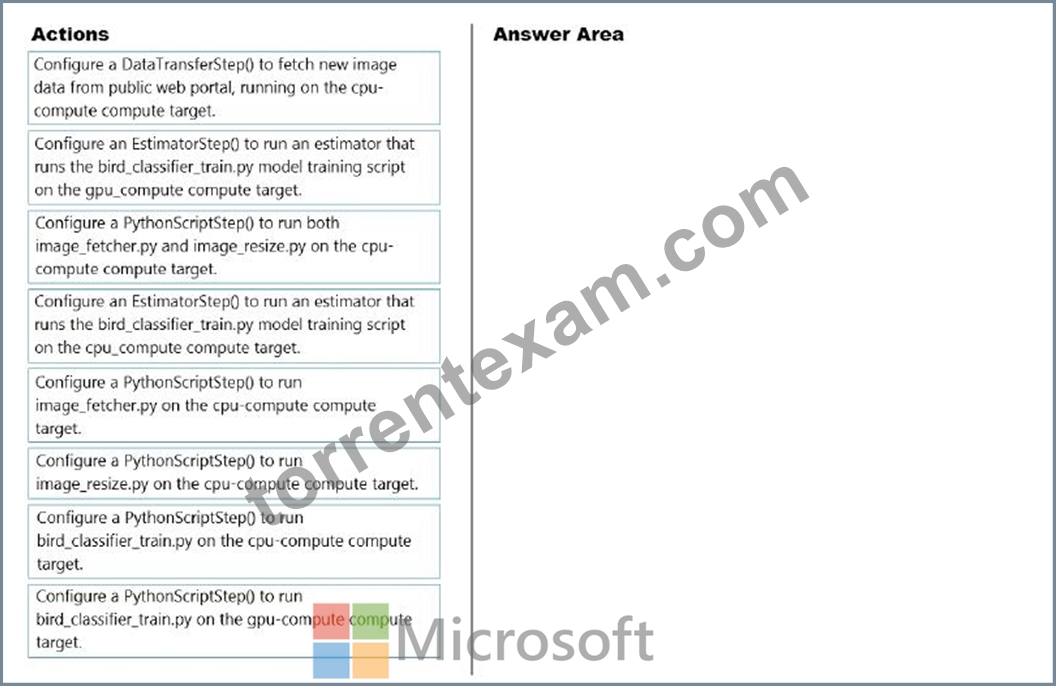
Answer:
Explanation: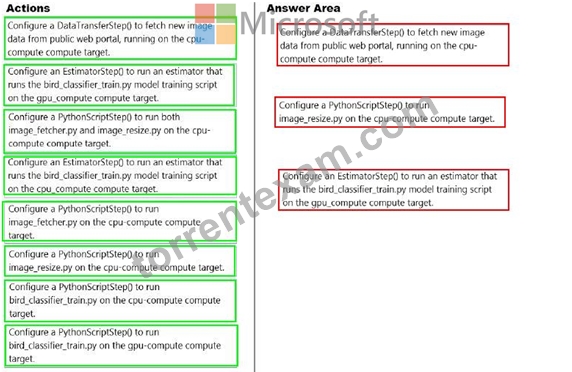
Reference:
https://docs.microsoft.com/en-us/azure/machine-learning/how-to-train-pytorch
NEW QUESTION # 87
You need to implement a scaling strategy for the local penalty detection data.
Which normalization type should you use?
- A. Batch
- B. Cosine
- C. Weight
- D. Streaming
Answer: A
Explanation:
Explanation/Reference:
Explanation:
Post batch normalization statistics (PBN) is the Microsoft Cognitive Toolkit (CNTK) version of how to evaluate the population mean and variance of Batch Normalization which could be used in inference Original Paper.
In CNTK, custom networks are defined using the BrainScriptNetworkBuilder and described in the CNTK network description language "BrainScript." Scenario:
Local penalty detection models must be written by using BrainScript.
References:
https://docs.microsoft.com/en-us/cognitive-toolkit/post-batch-normalization-statistics Testlet 2 Case study Overview You are a data scientist for Fabrikam Residences, a company specializing in quality private and commercial property in the United States. Fabrikam Residences is considering expanding into Europe and has asked you to investigate prices for private residences in major European cities. You use Azure Machine Learning Studio to measure the median value of properties. You produce a regression model to predict property prices by using the Linear Regression and Bayesian Linear Regression modules.
Datasets
There are two datasets in CSV format that contain property details for two cities, London and Paris, with the following columns: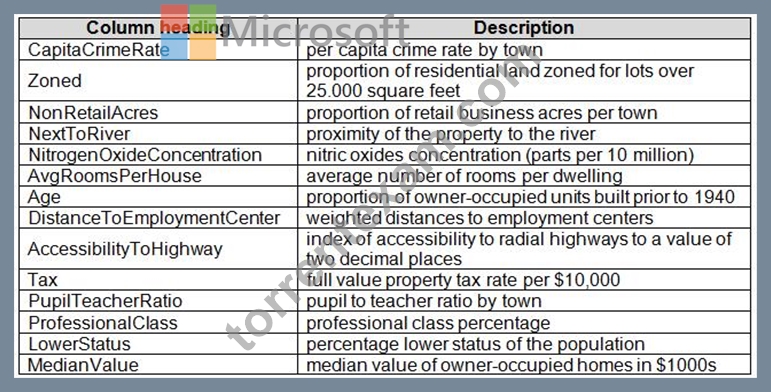
The two datasets have been added to Azure Machine Learning Studio as separate datasets and included as the starting point of the experiment.
Dataset issues
The AccessibilityToHighway column in both datasets contains missing values. The missing data must be replaced with new data so that it is modeled conditionally using the other variables in the data before filling in the missing values.
Columns in each dataset contain missing and null values. The dataset also contains many outliers. The Age column has a high proportion of outliers. You need to remove the rows that have outliers in the Age column. The MedianValue and AvgRoomsinHouse columns both hold data in numeric format. You need to select a feature selection algorithm to analyze the relationship between the two columns in more detail.
Model fit
The model shows signs of overfitting. You need to produce a more refined regression model that reduces the overfitting.
Experiment requirements
You must set up the experiment to cross-validate the Linear Regression and Bayesian Linear Regression modules to evaluate performance.
In each case, the predictor of the dataset is the column named MedianValue. An initial investigation showed that the datasets are identical in structure apart from the MedianValue column. The smaller Paris dataset contains the MedianValue in text format, whereas the larger London dataset contains the MedianValue in numerical format. You must ensure that the datatype of the MedianValue column of the Paris dataset matches the structure of the London dataset.
You must prioritize the columns of data for predicting the outcome. You must use non-parameters statistics to measure the relationships.
You must use a feature selection algorithm to analyze the relationship between the MedianValue and AvgRoomsinHouse columns.
Model training
Given a trained model and a test dataset, you need to compute the permutation feature importance scores of feature variables. You need to set up the Permutation Feature Importance module to select the correct metric to investigate the model's accuracy and replicate the findings.
You want to configure hyperparameters in the model learning process to speed the learning phase by using hyperparameters. In addition, this configuration should cancel the lowest performing runs at each evaluation interval, thereby directing effort and resources towards models that are more likely to be successful.
You are concerned that the model might not efficiently use compute resources in hyperparameter tuning.
You also are concerned that the model might prevent an increase in the overall tuning time. Therefore, you need to implement an early stopping criterion on models that provides savings without terminating promising jobs.
Testing
You must produce multiple partitions of a dataset based on sampling using the Partition and Sample module in Azure Machine Learning Studio. You must create three equal partitions for cross-validation. You must also configure the cross-validation process so that the rows in the test and training datasets are divided evenly by properties that are near each city's main river. The data that identifies that a property is near a river is held in the column named NextToRiver. You want to complete this task before the data goes through the sampling process.
When you train a Linear Regression module using a property dataset that shows data for property prices for a large city, you need to determine the best features to use in a model. You can choose standard metrics provided to measure performance before and after the feature importance process completes. You must ensure that the distribution of the features across multiple training models is consistent.
Data visualization
You need to provide the test results to the Fabrikam Residences team. You create data visualizations to aid in presenting the results.
You must produce a Receiver Operating Characteristic (ROC) curve to conduct a diagnostic test evaluation of the model. You need to select appropriate methods for producing the ROC curve in Azure Machine Learning Studio to compare the Two-Class Decision Forest and the Two-Class Decision Jungle modules with one another.
Question Set 3
NEW QUESTION # 88
You are creating a machine learning model in Python. The provided dataset contains several numerical columns and one text column. The text column represents a product's category. The product category will always be one of the following:
Bikes
Cars
Vans
Boats
You are building a regression model using the scikit-learn Python package.
You need to transform the text data to be compatible with the scikit-learn Python package.
How should you complete the code segment? To answer, select the appropriate options in the answer area.
NOTE: Each correct selection is worth one point.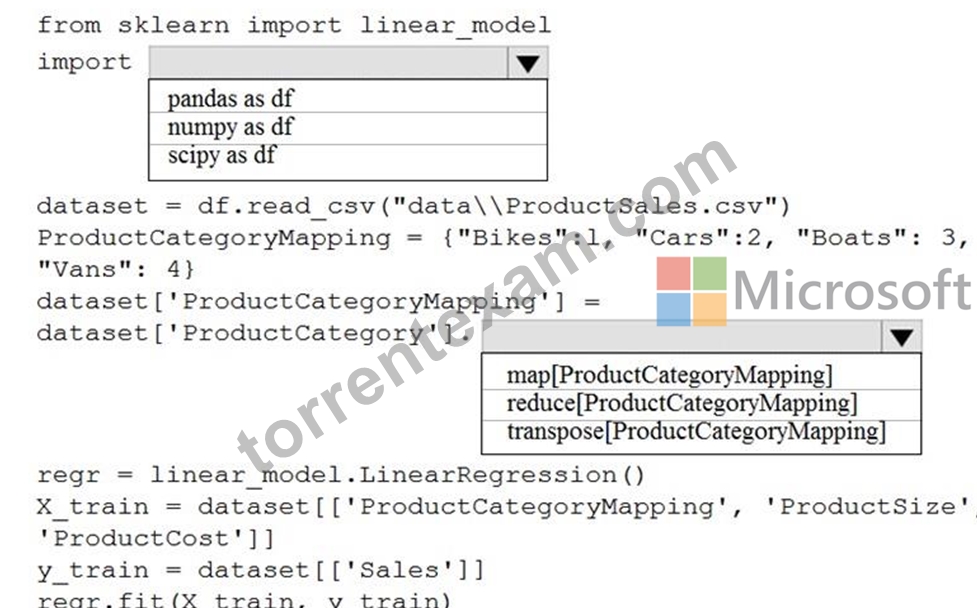
Answer:
Explanation: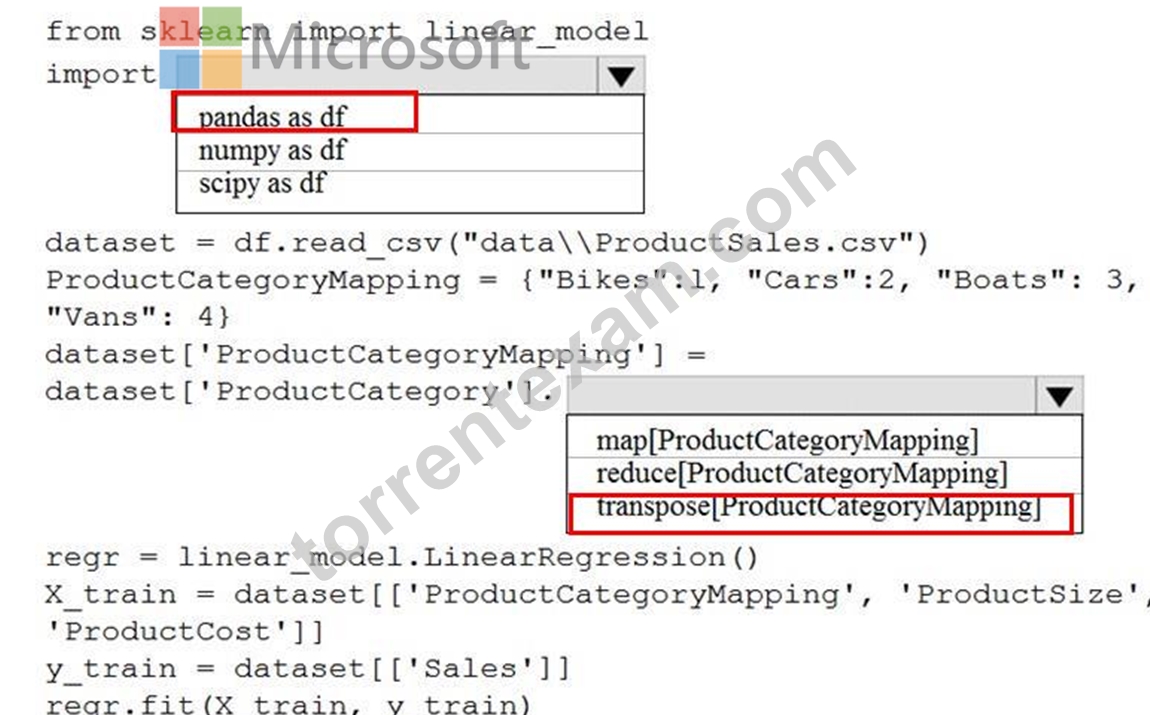
Reference:
https://datascienceplus.com/linear-regression-in-python/
NEW QUESTION # 89
You run a script as an experiment in Azure Machine Learning.
You have a Run object named run that references the experiment run. You must review the log files that were generated during the experiment run.
You need to download the log files to a local folder for review.
Which two code segments can you run to achieve this goal? Each correct answer presents a complete solution.
NOTE: Each correct selection is worth one point.
- A. run.download_files(output_directory='./runfiles')
- B. run.get_metrics()
- C. run.get_details()
- D. run.get_file_names()
- E. run.get_all_logs(destination='./runlogs')
Answer: C,E
Explanation:
The run Class get_all_logs method downloads all logs for the run to a directory.
The run Class get_details gets the definition, status information, current log files, and other details of the run.
Reference:
https://docs.microsoft.com/en-us/python/api/azureml-core/azureml.core.run(class)
NEW QUESTION # 90
You are the owner of an Azure Machine Learning workspace.
You must prevent the creation or deletion of compute resources by using a custom role. You must allow all other operations inside the workspace.
You need to configure the custom role.
How should you complete the configuration? To answer, select the appropriate options in the answer area.
NOTE: Each correct selection is worth one point.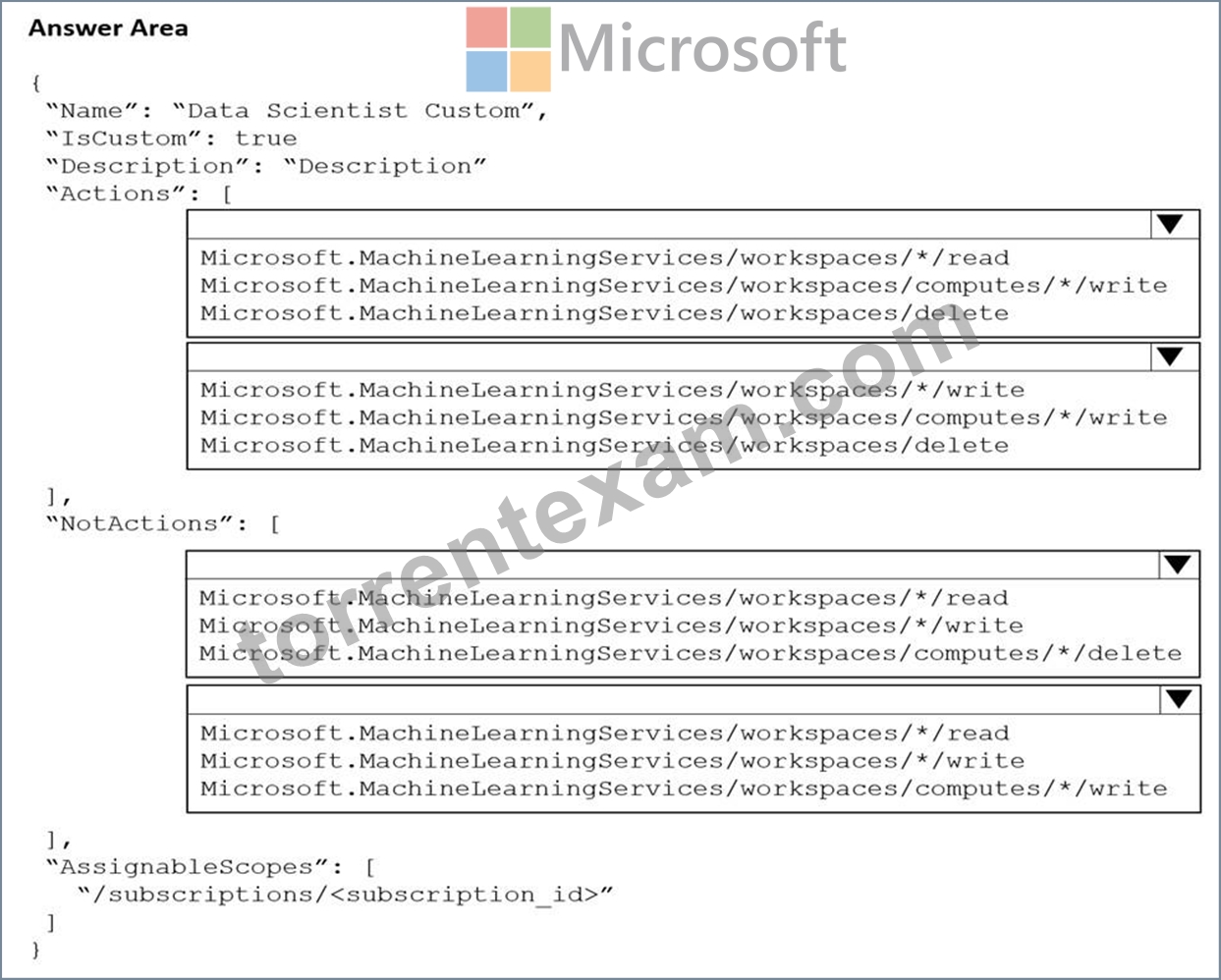
Answer:
Explanation: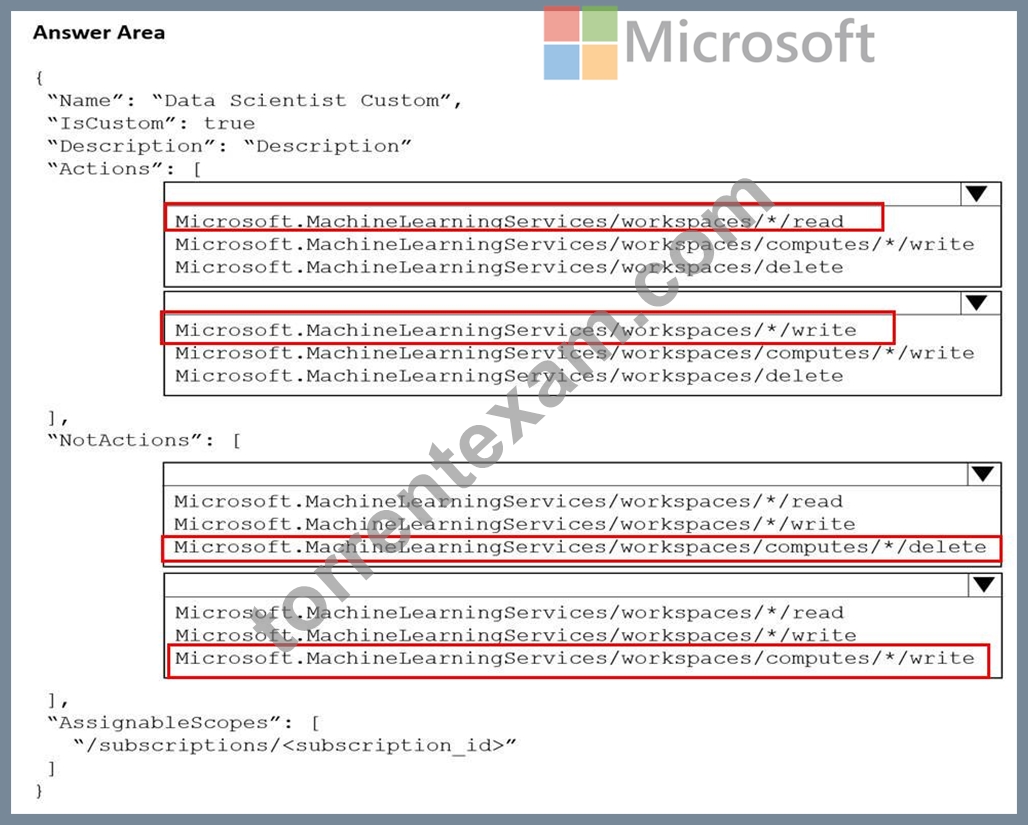
Reference:
https://docs.microsoft.com/en-us/azure/role-based-access-control/overview#how-azure-rbac-determines-if-a-user-has-access-to-a-resource
NEW QUESTION # 91
You have a dataset created for multiclass classification tasks that contains a normalized numerical feature set with 10,000 data points and 150 features.
You use 75 percent of the data points for training and 25 percent for testing. You are using the scikit-learn machine learning library in Python. You use X to denote the feature set and Y to denote class labels.
You create the following Python data frames:
You need to apply the Principal Component Analysis (PCA) method to reduce the dimensionality of the feature set to 10 features in both training and testing sets.
How should you complete the code segment? To answer, select the appropriate options in the answer area.
NOTE: Each correct selection is worth one point.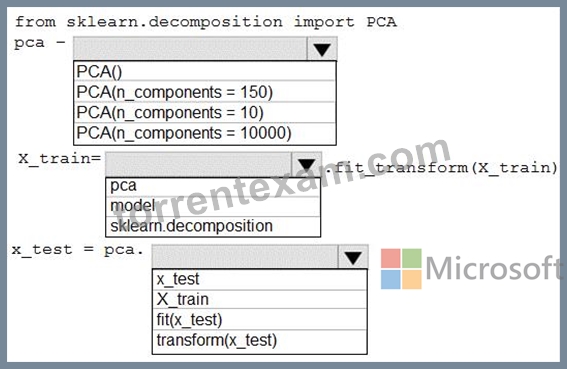
Answer:
Explanation: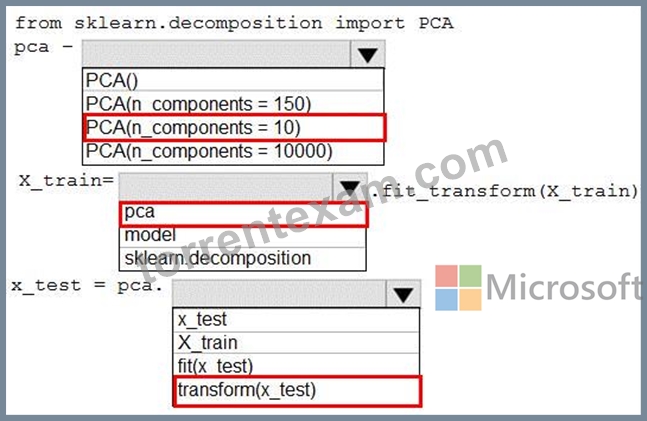
Reference:
https://scikit-learn.org/stable/modules/generated/sklearn.decomposition.PCA.html
NEW QUESTION # 92
You are developing a hands-on workshop to introduce Docker for Windows to attendees.
You need to ensure that workshop attendees can install Docker on their devices.
Which two prerequisite components should attendees install on the devices? Each correct answer presents part of the solution.
NOTE: Each correct selection is worth one point.
- A. BIOS-enabled virtualization
- B. Kitematic
- C. Microsoft Hardware-Assisted Virtualization Detection Tool
- D. VirtualBox
- E. Windows 10 64-bit Professional
Answer: A,E
Explanation:
C: Make sure your Windows system supports Hardware Virtualization Technology and that virtualization is enabled.
Ensure that hardware virtualization support is turned on in the BIOS settings. For example: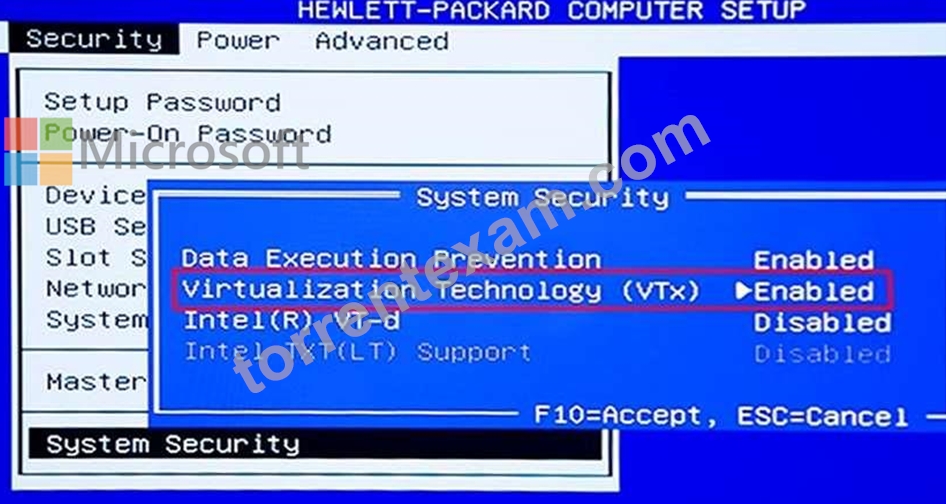
E: To run Docker, your machine must have a 64-bit operating system running Windows 7 or higher.
Reference:
https://docs.docker.com/toolbox/toolbox_install_windows/
https://blogs.technet.microsoft.com/canitpro/2015/09/08/step-by-step-enabling-hyper-v-for-use-on-windows-10/
NEW QUESTION # 93
You have the following Azure subscriptions and Azure Machine Learning service work*spaces:
You need to obtain a reference to the mi-protect workspace
Solution: Run the following Python code.
Does the solution meet the goal?
- A. No
- B. Yes
Answer: B
NEW QUESTION # 94
A set of CSV files contains sales records. All the CSV files have the same data schema.
Each CSV file contains the sales record for a particular month and has the filename sales.csv. Each file in stored in a folder that indicates the month and year when the data was recorded. The folders are in an Azure blob container for which a datastore has been defined in an Azure Machine Learning workspace. The folders are organized in a parent folder named sales to create the following hierarchical structure: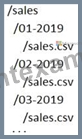
At the end of each month, a new folder with that month's sales file is added to the sales folder.
You plan to use the sales data to train a machine learning model based on the following requirements:
You must define a dataset that loads all of the sales data to date into a structure that can be easily converted to a dataframe.
You must be able to create experiments that use only data that was created before a specific previous month, ignoring any data that was added after that month.
You must register the minimum number of datasets possible.
You need to register the sales data as a dataset in Azure Machine Learning service workspace.
What should you do?
- A. Create a tabular dataset that references the datastore and specifies the path 'sales/*/sales.csv', register the dataset with the name sales_dataset and a tag named month indicating the month and year it was registered, and use this dataset for all experiments.
- B. Create a new tabular dataset that references the datastore and explicitly specifies each 'sales/mm-yyyy/ sales.csv' file every month. Register the dataset with the name sales_dataset_MM-YYYY each month with appropriate MM and YYYY values for the month and year. Use the appropriate month-specific dataset for experiments.
- C. Create a tabular dataset that references the datastore and explicitly specifies each 'sales/mm-yyyy/ sales.csv' file every month. Register the dataset with the name sales_dataset each month, replacing the existing dataset and specifying a tag named indicating the month and year it was registered. Use this dataset for all experiments.
- D. Create a tabular dataset that references the datastore and explicitly specifies each 'sales/mm-yyyy/ sales.csv' file. Register the dataset with the name sales_dataset each month as a new version and with a tag named month indicating the month and year it was registered. Use this dataset for all experiments, identifying the version to be used based on the month tag as necessary.
Answer: A
Explanation:
Explanation
Specify the path.
Example:
The following code gets the workspace existing workspace and the desired datastore by name. And then passes the datastore and file locations to the path parameter to create a new TabularDataset, weather_ds.
from azureml.core import Workspace, Datastore, Dataset
datastore_name = 'your datastore name'
# get existing workspace
workspace = Workspace.from_config()
# retrieve an existing datastore in the workspace by name
datastore = Datastore.get(workspace, datastore_name)
# create a TabularDataset from 3 file paths in datastore
datastore_paths = [(datastore, 'weather/2018/11.csv'),
(datastore, 'weather/2018/12.csv'),
(datastore, 'weather/2019/*.csv')]
weather_ds = Dataset.Tabular.from_delimited_files(path=datastore_paths)
NEW QUESTION # 95
You configure a Deep Learning Virtual Machine for Windows.
You need to recommend tools and frameworks to perform the following:
Build deep rwur.il network (DNN) models.
Perform interactive data exploration and visualization.
Which tools and frameworks should you recommend? To answer, drag the appropriate tools to the correct tasks. Each tool may be used once, more than once, or not at all. You may need to drag the split bar between panes or scroll to view content.
NOTE: Each correct selection is worth one point.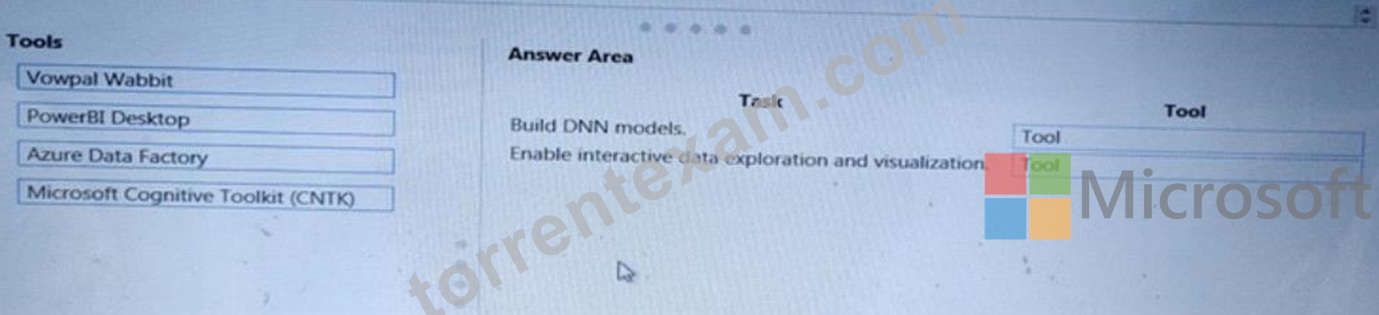
Answer:
Explanation: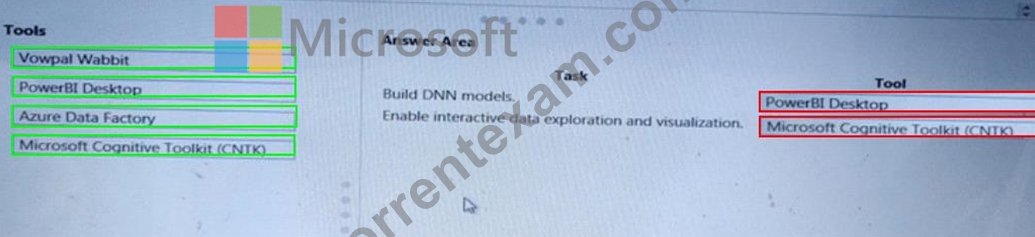
NEW QUESTION # 96
You create an experiment in Azure Machine Learning Studio. You add a training dataset that contains 10,000 rows. The first 9,000 rows represent class 0 (90 percent).
The remaining 1,000 rows represent class 1 (10 percent).
The training set is imbalances between two classes. You must increase the number of training examples for class 1 to 4,000 by using 5 data rows. You add the Synthetic Minority Oversampling Technique (SMOTE) module to the experiment.
You need to configure the module.
Which values should you use? To answer, select the appropriate options in the dialog box in the answer area.
NOTE: Each correct selection is worth one point.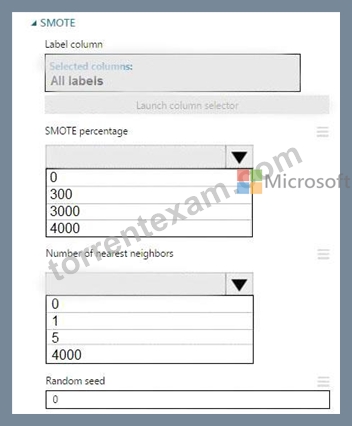
Answer:
Explanation: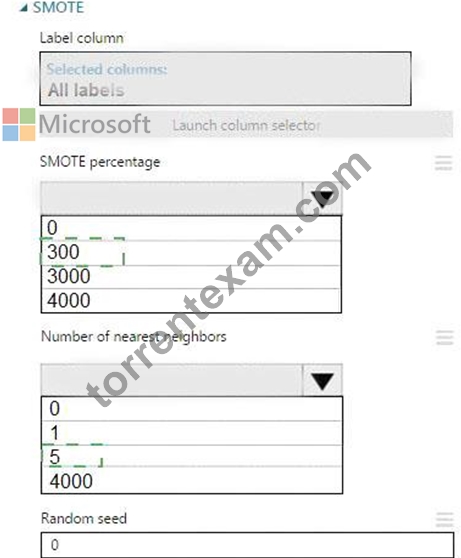
Explanation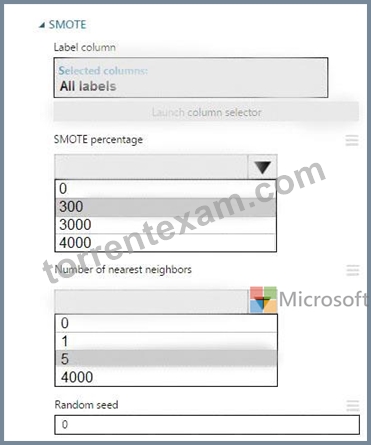
Box 1: 300
You type 300 (%), the module triples the percentage of minority cases (3000) compared to the original dataset (1000).
Box 2: 5
We should use 5 data rows.
Use the Number of nearest neighbors option to determine the size of the feature space that the SMOTE algorithm uses when in building new cases. A nearest neighbor is a row of data (a case) that is very similar to some target case. The distance between any two cases is measured by combining the weighted vectors of all features.
By increasing the number of nearest neighbors, you get features from more cases.
By keeping the number of nearest neighbors low, you use features that are more like those in the original sample.
References:
https://docs.microsoft.com/en-us/azure/machine-learning/studio-module-reference/smote
NEW QUESTION # 97
You need to define an evaluation strategy for the crowd sentiment models.
Which three actions should you perform in sequence? To answer, move the appropriate actions from the list of actions to the answer area and arrange them in the correct order.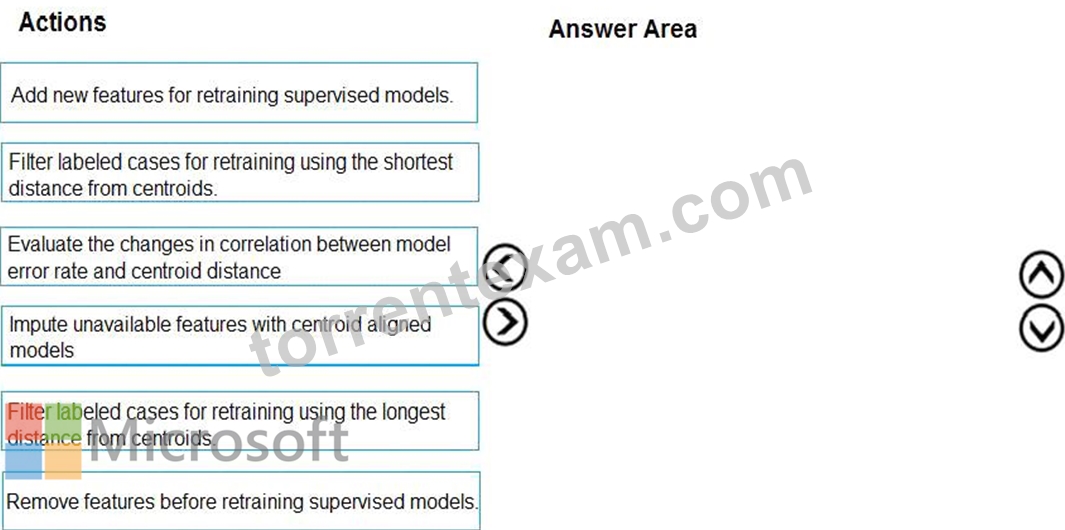
Answer:
Explanation: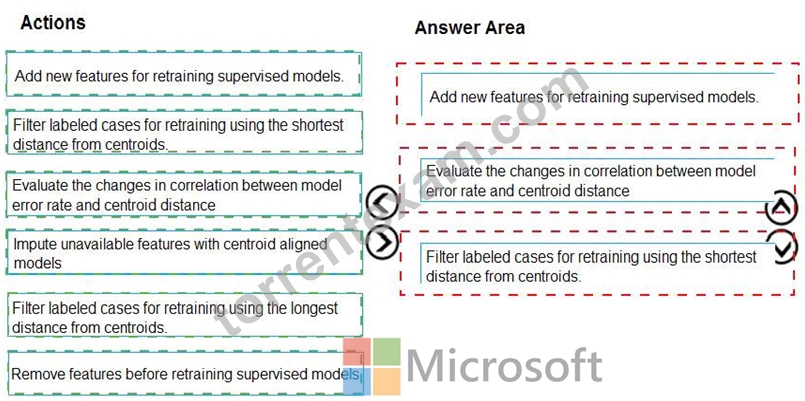
Explanation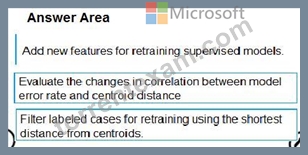
Scenario:
Experiments for local crowd sentiment models must combine local penalty detection data.
Crowd sentiment models must identify known sounds such as cheers and known catch phrases. Individual crowd sentiment models will detect similar sounds.
Note: Evaluate the changed in correlation between model error rate and centroid distance In machine learning, a nearest centroid classifier or nearest prototype classifier is a classification model that assigns to observations the label of the class of training samples whose mean (centroid) is closest to the observation.
References:
https://en.wikipedia.org/wiki/Nearest_centroid_classifier
https://docs.microsoft.com/en-us/azure/machine-learning/studio-module-reference/sweep-clustering
NEW QUESTION # 98
You create a machine learning model by using the Azure Machine Learning designer. You publish the model as a real-time service on an Azure Kubernetes Service (AKS) inference compute cluster. You make no changes to the deployed endpoint configuration.
You need to provide application developers with the information they need to consume the endpoint.
Which two values should you provide to application developers? Each correct answer presents part of the solution.
NOTE: Each correct selection is worth one point.
- A. The URL of the endpoint.
- B. The run ID of the inference pipeline experiment for the endpoint.
- C. The name of the AKS cluster where the endpoint is hosted.
- D. The key for the endpoint.
- E. The name of the inference pipeline for the endpoint.
Answer: A,D
Explanation:
Explanation
Deploying an Azure Machine Learning model as a web service creates a REST API endpoint. You can send data to this endpoint and receive the prediction returned by the model.
You create a web service when you deploy a model to your local environment, Azure Container Instances, Azure Kubernetes Service, or field-programmable gate arrays (FPGA). You retrieve the URI used to access the web service by using the Azure Machine Learning SDK. If authentication is enabled, you can also use the SDK to get the authentication keys or tokens.
Example:
# URL for the web service
scoring_uri = '<your web service URI>'
# If the service is authenticated, set the key or token
key = '<your key or token>'
Reference:
https://docs.microsoft.com/en-us/azure/machine-learning/how-to-consume-web-service
NEW QUESTION # 99
You have a comma-separated values (CSV) file containing data from which you want to train a classification model.
You are using the Automated Machine Learning interface in Azure Machine Learning studio to train the classification model. You set the task type to Classification.
You need to ensure that the Automated Machine Learning process evaluates only linear models.
What should you do?
- A. Set the Exit criterion option to a metric score threshold.
- B. Clear the option to enable deep learning.
- C. Set the task type to Regression
- D. Clear the option to perform automatic featurization.
- E. Add all algorithms other than linear ones to the blocked algorithms list.
Answer: D
Explanation:
Explanation
Automatic featurization can fit non-linear models.
Reference:
https://econml.azurewebsites.net/spec/estimation/dml.html
https://docs.microsoft.com/en-us/azure/machine-learning/how-to-use-automated-ml-for-ml-models
NEW QUESTION # 100
Note: This question is part of a series of questions that present the same scenario. Each question in the series contains a unique solution that might meet the stated goals. Some question sets might have more than one correct solution, while others might not have a correct solution.
After you answer a question in this section, you will NOT be able to return to it. As a result, these questions will not appear in the review screen.
You are creating a new experiment in Azure Machine Learning Studio.
One class has a much smaller number of observations than the other classes in the training set.
You need to select an appropriate data sampling strategy to compensate for the class imbalance.
Solution: You use the Scale and Reduce sampling mode.
Does the solution meet the goal?
- A. Yes
- B. No
Answer: B
NEW QUESTION # 101
......
Get Ready to Pass the DP-100 exam with Microsoft Latest Practice Exam : https://www.torrentexam.com/DP-100-exam-latest-torrent.html
Get Prepared for Your DP-100 Exam With Actual Microsoft Study Guide!: https://drive.google.com/open?id=144vWo-PKiK119ZkpT7Kw-U9Y62IhI1n2
