

Latest Dec 09, 2021 Real Associate-Cloud-Engineer Exam Dumps Questions Valid Associate-Cloud-Engineer Dumps PDF
Google Associate-Cloud-Engineer Exam Dumps - PDF Questions and Testing Engine
Books and Additional Resources
There are various books on Amazon that can help you prepare for the Google Associate Cloud Engineer test such as:
- Google Certified Associate Cloud Engineer Technology workbook by IP specialist. This book will help you enhance your ability to understand monitoring operations, deploying applications, and managing enterprise solutions. So, you will gain in-depth knowledge in using the GCP Console and the CLI to perform common platform-based tasks for the maintenance of one or more deployed solutions that leverage services on Google Cloud.
- Google Cloud: GCP: Google Cloud Platform: Associate Cloud Engineer Practice Test 2021 by Anthony Stewart. This book is an A to Z guide that efficiently teaches the skills that are required by the Associate Cloud Engineer certification. Thus, it covers topics such as management of enterprise solutions, deploying applications, and monitoring operations. At the same time, this is a good book for beginners as it does not require students to already have previous experience, going in. It also aids potential test-takers to demonstrate their skills through a certification exam that requires the ability to use the command-line and the GCP console to perform many general platform-based tasks.
- Google Cloud Certified Associate Cloud Engineer Certification Guide 1: Learn with challenge labs, assessment tests and practice exams to build innovations and real-life experiences by A. B. Lawal. This study guide is one of the most up-to-date books that can get you from the current level you are at, to passing the Google Associate Cloud Engineer certification exam. All of this is due to the fact that this book has additional tasks such as challenge labs, assessment tests bank, and flashcard banks to raise your self-assurance. Moreover, it also offers practice exam questions along with their correct answers and remarks as well as downloadable screenshots and summaries for quick exam revision to fully prepare you.
- One of the most recommended books is the Official Google Cloud Certified Associate Cloud Engineer Study Guide (1st Edition) by Dan Sullivan. This study guide presents everything you need to know to pass this crucial exam. You can master the knowledge required to obtain the Google Cloud Engineer certification and demonstrate your skillset needed to operate and deploy services, infrastructure, and networks in Google Cloud. The book prepares you to step-by-step studies with a pre-book official test to evaluate what you know before you start, exam objectives, and review questions in each chapter. Moreover, you will access the online learning environment, which will help you sharpen your knowledge with practice tests.
- Google Cloud Certified Associate Cloud Engineer All-in-One Exam Guide 1st Edition by Jack Hyman. This book is written by a cloud computing expert and educator in this field. By ordering this edition from Amazon, you will get an exam guide based on proven experience and containing unique techniques that supply and reinforce practical skills through precise practice questions and detailed explanations of answers. Thus, you can gain confidence in planning, setting up, and configuring GCP; ensuring effective operation, and administering access and security, which helps you to pass the Associate Cloud Engineer exam on your first attempt.
NEW QUESTION 91
Your company has a large quantity of unstructured data in different file formats. You want to perform ETL transformations on the data. You need to make the data accessible on Google Cloud so it can be processed by a Dataflow job. What should you do?
- A. Upload the data into Cloud SQL using the import function in the console.
- B. Upload the data into Cloud Spanner using the import function in the console.
- C. Upload the data to Cloud Storage using the gsutil command line tool.
- D. Upload the data to BigQuery using the bq command line tool.
Answer: C
NEW QUESTION 92
You need to grant access for three users so that they can view and edit table data on a Cloud Spanner instance. What should you do?
- A. Run gcloud iam roles describe roles/spanner.databaseUser. Add the users to the role.
- B. Run gcloud iam roles describe roles/spanner.viewer - -project my-project. Add the users to the role.
- C. Run gcloud iam roles describe roles/spanner.databaseUser. Add the users to a new group.
Add the group to the role. - D. Run gcloud iam roles describe roles/spanner.viewer - -project my-project. Add the users to a new group. Add the group to the role.
Answer: A
NEW QUESTION 93
Your organization has three existing Google Cloud projects. You need to bill the Marketing department for only their Google Cloud services for a new initiative within their group. What should you do?
- A. 1. Verify that you are assigned the Billing Administrator IAM role for your organization's Google Cloud account
2. Create a new Google Cloud Project for the Marketing department
3. Set the default key-value project labels to department marketing for all services in this project - B. 1. Verify that you ace assigned the Billing Administrator IAM role tor your organization's Google Cloud Project for the Marketing department
2. Link the new project to a Marketing Billing Account - C. 1. Verify that you are assigned the Organization Administrator IAM role for your organization's Google Cloud account
2. Create a new Google Cloud Project for the Marketing department 3. Link the new project to a Marketing Billing Account. - D. 1. Verity that you are assigned the Organization Administrator IAM role for your organization's Google Cloud account
2. Create a new Google Cloud Project for the Marketing department
3. Set the default key value project labels to department marketing for all services in this protect
Answer: B
NEW QUESTION 94
Your company set up a complex organizational structure on Google Cloud. The structure includes hundreds of folders and projects. Only a few team members should be able to view the hierarchical structure. You need to assign minimum permissions to these team members, and you want to follow Google-recommended practices.
What should you do?
- A. Add the users to a group, and add this group to roles/browser.
- B. Add the users to roles/iam.roleViewer role.
- C. Add the users to roles/browser role.
- D. Add the users to a group, and add this group to roles/iam.roleViewer role.
Answer: A
NEW QUESTION 95
You manage three Google Cloud projects with the Cloud Monitoring API enabled. You want to follow Google-recommended practices to visualize CPU and network metrics for all three projects together. What should you do?
- A. 1 Create a Service Account and apply roles/viewer on the three projects
2. Collect metrics and publish them lo the Cloud Monitoring API
3. Add CPU and network Charts for each of the three projects. - B. 1. Create a Cloud Monitoring Dashboard
2. Collect metrics and publish them into the Pub/Sub topics 3. Add CPU and network Charts (or each of (he three projects - C. 1. Create a Cloud Monitoring Dashboard.
2. Select the CPU and Network metrics from the three projects.
3. Add CPU and network Charts lot each of the three protects. - D. 1. Create a fourth Google Cloud project
2 Create a Cloud Workspace from the fourth project and add the other three projects
Answer: C
NEW QUESTION 96
You have a Dockerfile that you need to deploy on Kubernetes Engine. What should you do?
- A. Create a docker image from the Dockerfile and upload it to Container Registry. Create a Deployment YAML file to point to that image. Use kubectl to create the deployment with that file.
- B. Use gcloud app deploy <dockerfilename>.
- C. Use kubectl app deploy <dockerfilename>.
- D. Create a docker image from the Dockerfile and upload it to Cloud Storage. Create a Deployment YAML file to point to that image. Use kubectl to create the deployment with that file.
Answer: A
NEW QUESTION 97
You are running multiple VPC-native Google Kubernetes Engine clusters in the same subnet. The IPs available for the nodes are exhausted, and you want to ensure that the clusters can grow in nodes when needed. What should you do?
- A. Add an alias IP range to the subnet used by the GKE clusters.
- B. Expand the CIDR range of the relevant subnet for the cluster.
:
To create a VPC peering connection, first create a request to peer with another VPC. - C. Create a new subnet in the same region as the subnet being used.
- D. Create a new VPC, and set up VPC peering with the existing VPC.
Answer: D
Explanation:
Reference:
https://docs.aws.amazon.com/vpc/latest/peering/vpc-pg.pdf
NEW QUESTION 98
You have an App Engine application serving as your front-end. It's going to publish messages to Pub/Sub. The Pub/Sub API hasn't been enabled yet. What is the fastest way to enable the API?
- A. Use a service account to auto-enable the API.
- B. Enable the API in the Console.
- C. The API will be enabled the first time the code attempts to access Pub/Sub.
- D. Application's in App Engine don't require external APIs to be enabled.
Answer: B,C
NEW QUESTION 99
Your team uses a third-party monitoring solution. They've asked you to deploy it to the nodes in your Kubernetes Engine Cluster. What's the best way to do that?
- A. Use Deployment Manager to deploy the monitoring solution.
- B. Deploy the monitoring pod as a DaemonSet.
- C. Connect to each node via SSH and install the monitoring solution.
- D. Deploy the monitoring pod as a Deployment.
Answer: B
NEW QUESTION 100
You want to select and configure a cost-effective solution for relational data on Google Cloud Platform. You are working with a small set of operational data in one geographic location. You need to support point-in-time recovery. What should you do?
- A. Select Cloud SQL (MySQL). Select the create failover replicas option.
- B. Select Cloud Spanner. Set up your instance as multi-regional.
- C. Select Cloud Spanner. Set up your instance with 2 nodes.
- D. Select Cloud SQL (MySQL). Verify that the enable binary logging option is selected.
Answer: D
Explanation:
Reference:
https://cloud.google.com/sql/docs/mysql/backup-recovery/restore
NEW QUESTION 101
You want to verify the IAM users and roles assigned within a GCP project named my-project.
What should you do?
- A. Run gcloud iam service-accounts list. Review the output section.
- B. Navigate to the project and then to the IAM section in the GCP Console. Review the members and roles.
- C. Navigate to the project and then to the Roles section in the GCP Console. Review the roles and status.
- D. Run gcloud iam roles list. Review the output section.
Answer: C
NEW QUESTION 102
You are monitoring an application and receive user feedback that a specific error is spiking. You notice that the error is caused by a Service Account having insufficient permissions. You are able to solve the problem but want to be notified if the problem recurs. What should you do?
- A. Create a custom log-based metrics for the specific error to be used in an Alerting Policy.
- B. Grant Project Owner access to the Service Account.
- C. Create a sink to BigQuery to export all the logs.
Create a Data Studio dashboard on the exported logs. - D. In the Log Viewer, filter the logs on severity `Error' and the name of the Service Account.
Answer: D
Explanation:
https://cloud.google.com/logging/docs/view/advanced-queries8E6BA412E7DB6A14A62CC68E5EB6DAE3
NEW QUESTION 103
You have a Dockerfile that you need to deploy on Kubernetes Engine. What should you do?
- A. Create a docker image from the Dockerfile and upload it to Container Registry. Create a Deployment YAML file to point to that image. Use kubectl to create the deployment with that file.
- B. Use gcloud app deploy <dockerfilename>.
- C. Use kubectl app deploy <dockerfilename>.
- D. Create a docker image from the Dockerfile and upload it to Cloud Storage. Create a Deployment YAML file to point to that image. Use kubectl to create the deployment with that file.
Answer: A
Explanation:
Reference https://cloud.google.com/kubernetes-engine/docs/tutorials/hello-app
NEW QUESTION 104
Your VMs are running in a subnet that has a subnet mask of 255.255.255.240. The current subnet has no more free IP addresses and you require an additional 10 IP addresses for new VMs. The existing and new VMs should all be able to reach each other without additional routes. What should you do?
- A. Create a new subnet with the same starting IP but a wider range to overwrite the current subnet.
- B. Create a new project. Use Shared VPC to share the current network with the new project.
- C. Delete the subnet, and recreate it using a wider range of IP addresses.
- D. Use gcloud to expand the IP range of the current subnet.
Answer: B
NEW QUESTION 105
Your company has a 3-tier solution running on Compute Engine. The configuration of the current infrastructure is shown below.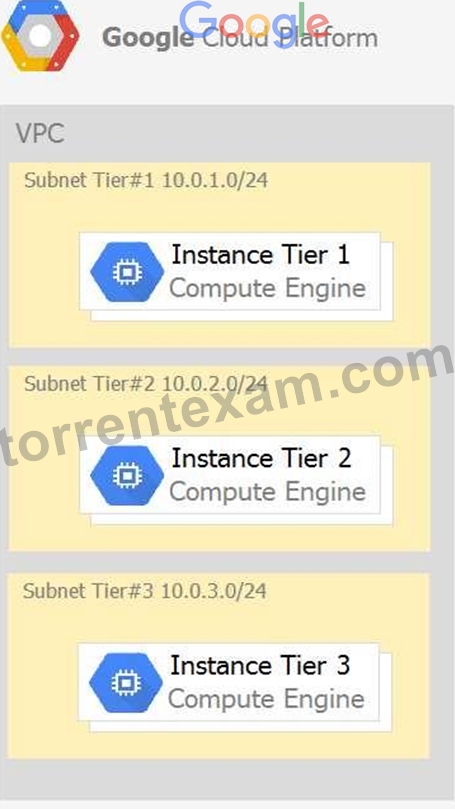
Each tier has a service account that is associated with all instances within it. You need to enable communication on TCP port 8080 between tiers as follows:
* Instances in tier #1 must communicate with tier #2.
* Instances in tier #2 must communicate with tier #3.
What should you do?
- A. 1. Create an ingress firewall rule with the following settings:
* Targets: all instances with tier #2 service account
* Source filter: all instances with tier #1 service account
* Protocols: allow all
2. Create an ingress firewall rule with the following settings:
* Targets: all instances with tier #3 service account
* Source filter: all instances with tier #2 service account
* Protocols: allow all - B. 1. Create an egress firewall rule with the following settings:
* Targets: all instances
* Source filter: IP ranges (with the range set to 10.0.2.0/24)
* Protocols: allow TCP: 8080
2. Create an egress firewall rule with the following settings:
* Targets: all instances
* Source filter: IP ranges (with the range set to 10.0.1.0/24)
* Protocols: allow TCP: 8080 - C. 1. Create an ingress firewall rule with the following settings:
* Targets: all instances
* Source filter: IP ranges (with the range set to 10.0.2.0/24)
* Protocols: allow all
2. Create an ingress firewall rule with the following settings:
* Targets: all instances
* Source filter: IP ranges (with the range set to 10.0.1.0/24)
* Protocols: allow all - D. 1. Create an ingress firewall rule with the following settings:
* Targets: all instances with tier #2 service account
* Source filter: all instances with tier #1 service account
* Protocols: allow TCP:8080
2. Create an ingress firewall rule with the following settings:
* Targets: all instances with tier #3 service account
* Source filter: all instances with tier #2 service account
* Protocols: allow TCP: 8080
Answer: D
NEW QUESTION 106
......
Reliable Google Cloud Certified Associate-Cloud-Engineer Dumps PDF Dec 09, 2021 Recently Updated Questions: https://www.torrentexam.com/Associate-Cloud-Engineer-exam-latest-torrent.html
Latest Associate-Cloud-Engineer Exam Dumps for Pass Guaranteed: https://drive.google.com/open?id=1nOlhuabQtrk9oZPbF0i0bmtJ4WZOHAi0
