

Pass ISQI ISTQB Certified Tester Advanced Level - Test Manager [Syllabus 2012] Exam in First Attempt Guaranteed Updated Dump from TorrentExam!
Pass CTAL-TM_Syll2012 Exam with 66 Questions - Verified By TorrentExam
NEW QUESTION 11
Test Management
You are managing the system testing for a SOA based system. The integrated system consists of several subsystems:
- a SOA middleware
- a CRM (Customer Relationship Management) system
- a BRM (Billing and Revenue Management) system
- a SMS (Subscriber Management System) system
and you performed a risk analysis based on these subsystems.
At the end of the scheduled period for test execution you produce a first classical report based on the traditional metrics of testing. Test pass/fail status and bug status (open/resolved) That table provides you a distorted picture of the quality risk, because there is no indication of the risk level of the failed tests, the tests not run, or the open bugs. Thus, you produce the following table to solve this distortion issue: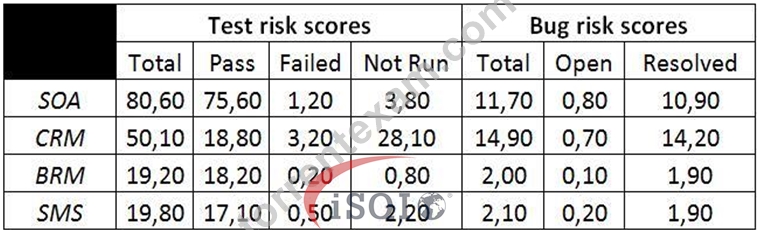
In the table above, where you have introduced the concept of risk weighting, the highest risk test or bug report has a score of 1, while the lowest risk test or bug report has a score of 0.04.
Which of the following subsystems, based on the risk scores of the table, is most risky?
Number of correct responses: 1
K4 3 credits
- A. BRM
- B. CRM
- C. SMS
- D. SOA
Answer: B
NEW QUESTION 12
People Skills - Team Composition
Which of the following would you expect to be most likely an example of a motivating factor for testers?
Number of correct responses: 1
K2 1 credit
- A. The resources allocated for the testing activities are not sufficient and don't allow the testers to contribute to the quality of the product
- B. The testers contribution to the quality of the software products developed from an organization is recognized with increased responsibilities
- C. The same regressions tests are executed manually by the same testers, for every product release, without any progression in content
- D. The testers are asked to perform, in parallel with their testing tasks, other tasks unrelated to their testing responsibilities
Answer: B
NEW QUESTION 13
Which of the following would you expect to be most likely an example of a demotivating factor for testers?
K2 1 credit
- A. The same regressions tests are manually executed by the same testers, for every product release, without regression test tools
- B. The testers' recommendations to improve the system or its testability are adopted by the development team
- C. The management asks the testers to be kept informed about the intensity, quality and results of testing
- D. The testers are assessed on whether and how often they detect important and critical failures
- E. Test quality is measured by counting the number of customer/user reported problems.
Answer: A,E
NEW QUESTION 14
Defect Management
Assume you are working on a defect management process to be used by a software organization to track the current status of the defects reports for several projects.
When a defect is found for investigation a defect report is created in "Opened" state that is the unique initial state. The defect report status has also a unique finale state that is the "Closed" state.
The following state transition diagram describes the states of this defect management process:
where only the initial ("Opened") and final ("Closed") states are indicated while the remaining states (V, W, X, Y, Z) have yet to be named.
Which of the following assignments would you expect to best complete the defect management process?
Number of correct responses: 1
K3 2 credits
- A. V=Rejected , W=Corrected , X=Validated, Y=Re-Opened, Z=Assigned
- B. V=Assigned, W=Validated , X=Corrected, Y=Re-Opened, Z=Rejected
- C. V=Assigned, W=Corrected , X=Validated, Y=Re-Opened, Z=Rejected
- D. V= Corrected, W=Assigned, X=Validated, Y=Corrected, Z=Rejected
Answer: C
NEW QUESTION 15
Which of the following statements about management of product quality risks in mature organizations with respect to the lifecycle, is true?
K2 1 credit
- A. Mature organizations are aware that risk management of product quality risks only occurs during testing
- B. Mature organizations are aware that the contribution of testing to analysis of product quality risks is very important. The analysis should occur throughout the entire lifecycle
- C. Mature organizations address product quality risks associated to non-functional characteristics only during the system test phase
- D. Mature organizations don't waste time identifying the sources of risks. They only focus on identifying product quality risks
Answer: B
NEW QUESTION 16
For which of the following activities would the costs be classified as a cost of detection?
K2 1 credit
- A. Re-running a test case, during the system testing phase, to verify that a fix eliminates a previously found defect
- B. Training developers to better understand the new features of the coding language they will use on the project
- C. Fixing field failures
- D. Writing test specifications according to the test design
Answer: D
NEW QUESTION 17
Testing Process
Which of the following statements describing the consequences of specifying test conditions at a detailed level is NOT true?
Number of correct responses: 1
K2 1 credit
- A. For system testing, the specification of test conditions at a detailed level, carried out early in the project as soon as the test basis is established, can contribute to defect prevention
- B. The specification of test conditions at a detailed level can be effective when no formal requirements or other development work products are available
- C. The specification of test conditions at a detailed level can require the implementation of an adequate level of formality across the team
- D. In an environment where the test basis is continuously changing, it is recommended to specify test conditions at a detailed level in order to achieve a better maintainability
Answer: D
NEW QUESTION 18
Test Management
You are the Test Manager on a project following an iterative life-cycle model. The project should consist of nine iterations of one month duration each. It is planned to develop the most important features to have a stable core of the application in the first three iterations and to add the additional features in the last six iterations.
At the beginning of the first iteration, only a draft version of the requirements specification document for the core features is available. Assume that during each of the first three iterations, the chosen features are fully completed and unit tested.
Which of the following statements is true in this context?
Number of correct responses: 1
K4 3 credits
- A. You should allocate all the effort for the system test phase only in the last iteration
- B. The system test phase should start when all the requirements are frozen
- C. You should allocate a large effort for system testing during the first three iterations
- D. You should apply the same test strategy as used in a sequential life cycle model
Answer: C
NEW QUESTION 19
Defect Management
Consider a defect report and assume that a part of its lifecycle includes the following states:
New: Is the initial state
Working: Means that the developers are addressing the defect in order to produce a fix for the defect Clarification: Means that the developers need more information from the tester to address the defect and produce a fix for the defect and the tester is working to provide this information to the developers Verification: Means that a fix for the defect has been produced and the tester is running the adequate tests to verify whether the fix solves the defect Closed: is the final state Which of the following answers represents an invalid sequence of states that can't lead the bug report to the
"Closed" state?
Number of correct responses: 1
K2 1 credit
- A. New, Working, Verification, Closed
- B. New, Working, Verification, Working, Clarification, Working, Closed
- C. New, Working, Verification, Working, Clarification, Working, Verification, Closed
- D. New, Working, Clarification, Working, Verification, Closed
Answer: B
NEW QUESTION 20
Test Management
Which of the following statements best describes an appropriate approach for managing exploratory testing?
Number of correct responses: 1
K2 1 credit
- A. Define very generic charters to drive exploratory testing sessions of 2 days where testers are completely free to decide what to test
- B. Exploratory testing should not be managed because such testing is inherently unmanageable and not measurable
- C. Define very detailed mission statements, which allow testing work to be broken into sessions of up to 10 minutes duration in which testing is guided by these mission statements
- D. Break the testing work in 30 to 120 minutes sessions and use properly defined mission statements consisting of two or three sentences to guide testing during these sessions
Answer: D
NEW QUESTION 21
Assume you are working on a defect management process to be used by a software organization to track the current status of the defects reports for several projects.
When a defect is found for investigation a defect report is created in "Opened" state that is the unique initial state. The defect report status has also a unique finale state that is the "Closed" state.
The following state transition diagram describes the states of this defect management process:
Where only the initial ("Opened") and final ("Closed") states are indicated while the remaining states (V, W, X, Y, Z) have yet to be named.
Which of the following assignments would you expect to best complete the defect management process?
K3 2 credits
- A. V=Rejected , W=Corrected , X=Validated, Y=Re-Opened, Z=Assigned
- B. V=Assigned, W=Validated , X=Corrected, Y=Re-Opened, Z=Rejected
- C. V=Assigned, W=Corrected , X=Validated, Y=Re-Opened, Z=Rejected
- D. V= Corrected, W=Assigned, X=Validated, Y=Corrected, Z=Rejected
Answer: C
NEW QUESTION 22
Test Management
You are the Test Manager of a new project aimed at developing a software system that must be certified at level B of the DO-178B standard. The project will follow a V-Model software development life cycle and it will have four formal levels of testing: component, integration, system and acceptance testing.
You must produce the test plan documentation for this project by providing an adequate coordination across the four levels of testing in order to assure auditability.
Which of the following answers would you expect to best describe how to organize the test plan?
- A. Produce a master test plan that covers three levels (component, integration, system test) and a separate acceptance test plan
- B. Produce a single master test plan that covers in detail all four levels, describing the particular activities for all test levels
- C. Produce a master test plan describing the relationship between the four levels, and four separate detailed level test plans, one for each level
- D. Produce four separate detailed level test plans, one for each level, without a master test plan
Answer: C
Explanation:
Section: Test Management
NEW QUESTION 23
Test Tools and Automation
Assume you are the Test Manager in charge of independent testing for avionics applications.
You are in charge of testing for a project to implement three different CSCI (Computer Software Configuration Item):
- a BOOT-X CSCI that must be certified at level B of the DO-178B standard
- a DIAG-X CSCI that must be certified at level C of the DO-178B standard
- a DRIV-X CSCI that must be certified at level A of the DO-178B standard These are three different software modules written in C language to run on a specific hardware platform.
You have been asked to select a single code coverage tool to perform the mandatory code coverage measurements, in order to meet the structural coverage criteria prescribed by the DO-178B standard. This tool must be qualified as a verification tool under DO-178B.
Since there are significant budget constraints to purchase this tool, you are evaluating an open-source tool that is able to provide different types of code coverage. This tool meets perfectly your technical needs in terms of the programming language and the specific hardware platform (it supports also the specific C- compiler).
The source code of the tool is available.
Your team could easily customize the tool to meet the project needs. This tool is not qualified as a verification tool under the DO-178B.
Which of the following are the three main concerns related to that open-source tool selection?
- A. What are the costs to qualify the tool as a verification tool under the DO-178B?
- B. Does the tool have a good general usability?
- C. Is the installation procedure of the tool easy?
- D. Does the tool require a system with more than 4GB of RAM memory?
- E. Does the tool support all the types of code coverage required from the three levels A, B, C of the DO-
178B standard? - F. Is the licensing scheme of the tool compatible with the confidentiality needs of the avionics company?
Answer: A,E,F
NEW QUESTION 24
You are using this skills assessment spreadsheet in order to define a training development plan for your test team.
Your objective is to fill the skill gaps by having at least a team member rated as an expert for each skill identified for the "technical expertise" and "testing skills" sections, and with the ability to train the other team members.
Considering the budget constraints you can send only one person to a training course.
Based only on the given information, which of the following answers would you expect to be the best option to achieve your objective?
- A. Send Alex to a performance testing training course
- B. Send Mark to a test automation training course
- C. Send Robert to a performance testing training course
- D. Send John to a performance testing training course
Answer: A
NEW QUESTION 25
You are the Test Manager of a new project that will have three formal levels of testinG. unit, integration and system testing. The testing strategy you decide to adopt a blend of risk-based testing and reactive testing strategies.
Which of the following answers describes the most consistent example of implementation of this test strategy during the execution of the system tests?
K2 1 credit
- A. Your test team executes scripted tests designed and implemented before the execution of the system test phase, to cover the identified product risks. It also performs exploratory testing sessions throughout the system test phase
- B. Your test team executes system tests under the guidance of a sample of users throughout the system test phase
- C. Your test team executes exploratory tests following a session-based test management approach throughout the system test phase
- D. Your test team autonomously performs some exploratory testing sessions and, at the very end of the system testing phase, it also executes more system tests under the guidance of a sample of users
Answer: A
NEW QUESTION 26
Assume you are managing the system testing phase of a project. The system test execution period is scheduled to twenty weeks.
All tests are manual tests. You are following a risk-driven test approach.
During the last staff meeting the project manager tells you new deadlines that will not allow completion of all the system tests.
Which of the following would you expect to be the best way to respond to this situation?
K2 1 credit
- A. Prioritize executing the tests for the highest product risks and track these risks
- B. Remove testers from your test team, so that they can be assigned to other projects
- C. No action is needed, test as much as possible in the remaining time period
- D. Automate all remaining tests
Answer: A
NEW QUESTION 27
Test Management
Consider the following test strategies:
I. Consultative test strategy
II. Reactive test strategy
III. Analytical test strategy
IV. Process-compliant test strategy
Consider also the following examples of test activities:
1. Prioritize the test cases, based on the results of a FMEA analysis, to ensure early coverage of the most important areas and discovery of the most important defects during test execution
2. Execute usability testing driven by the guidance of a sample of users (external to the test team)
3. Perform exploratory testing sessions throughout the system test phase
4. On an Agile project, execute tests that cover the test conditions identified for each user story of a feature planned for an iteration Which of the following correctly matches each test strategy with an appropriate example?
- A. I-2; II-3; III-1; IV-4
- B. I-1; II-2; III-3; IV-4
- C. I-3; II-2; III-1; IV-4
- D. I-2; II-3; III-4; IV-1
Answer: A
Explanation:
Section: Test Management
NEW QUESTION 28
......
Penetration testers simulate CTAL-TM_Syll2012 exam: https://www.torrentexam.com/CTAL-TM_Syll2012-exam-latest-torrent.html
Free Test Engine For ISTQB Certified Tester Advanced Level - Test Manager [Syllabus 2012] Certification Exams: https://drive.google.com/open?id=1r1lIXDLk4ck-D9k5SE8iQu7j5OnXS0iD
