

Accurate & Verified 2022 New 1Z1-083 Answers As Experienced in the Actual Test!
1Z1-083 Certification Sample Questions certification Exam
NEW QUESTION 42
Which three are true about requirements for various FLASHBACK operations? (Choose three.)
- A. FLASHBACK drop requires that the RECYCLEBIN parameter be set to ON.
- B. FLASHBACK DATA ARCHIVE requires undo to store all versions of all rows of a table being tracked.
- C. FLASHBACK transaction query requires undo to retrieve all versions of a row that existed between two points in time.
- D. FLASHBACK version query requires that the RECYCLEBIN parameter be set to ON.
- E. FLASHBACK drop requires undo to retrieve all versions of a row that existed between two points in time.
- F. FLASHBACK version query requires undo to retrieve all versions of a row that existed between two points in time.
Answer: A,C,F
NEW QUESTION 43
Examine this configuration:
1. CDB1 is a container database.
2. PDB1 and PDB2 are pluggable databases in CDB1.
You execute these commands successfully: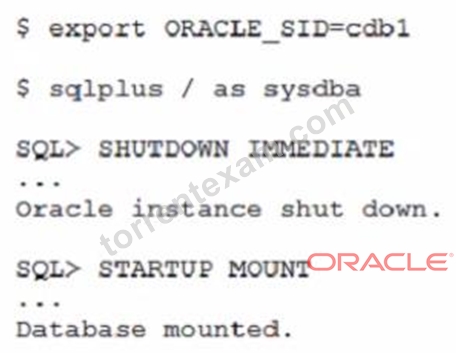
Which two are true?
- A. PDB$SEED is in read only state.
- B. Redo logs are opened.
- C. PDB1 and PDB2 are in read only state.
- D. PDB1 and PDB2 are in mount state.
- E. CDB$ROOT is in mount state.
Answer: B,C
NEW QUESTION 44
Which two are true about duplicating pluggable databases (PDBs) with RMAN? (Choose two.)
- A. The auxiliary instance is automatically created with ENABLE_PLUGGABLE_DATABASE = TRUE.
- B. A user with SYSDBA or SYSBACKUP must be logged in with RMAN to the PDB to duplicate it.
- C. Two or more PDBs can be duplicated with the same RMAN DUPLICATE command.
- D. CDB$ROOT and PDB$SEED are automatically duplicated.
- E. All tablespaces belonging to a PDB must be duplicated when duplicating the PDB.
Answer: A,B
NEW QUESTION 45
You execute this command successfully: SQL> ALTER DATABASE BACKUP CONTROLFILE TO TRACE; What is the outcome?
- A. It creates a file that contains SQL statements to re-create the control file.
- B. It updates the alert log with the location and contents of the control file
- C. It creates a file that contains RMAN scripts to create a duplicate database.
- D. It creates a copy of the control file in the fast recovery area (FRA).
- E. It creates a binary backup of the control file.
Answer: A
NEW QUESTION 46
Which three can be done using Oracle Database Configuration Assistant (DBCA) starting from Oracle Database 19c? (Choose three.)
- A. relocating a remote pluggable database in silent mode
- B. relocating a remote container database in silent mode
- C. relocating a remote container database in interactive mode
- D. relocating a remote pluggable database in interactive mode
- E. cloning a remote pluggable database in silent mode
- F. cloning a remote container database in interactive mode
- G. cloning a remote container database in silent mode
Answer: A,D,G
Explanation:
Explanation/Reference: https://docs.oracle.com/en/database/oracle/oracle-database/19/clone-pdbs-using-dbca-silent- mode/index.html?
learningpath=true&appuser=nobody&appsession=170971049395&contentid=26693&activityname=Clone%
20PDBs%20using%20DBCA%20in%20Silent%20Mode&eventid=6352
NEW QUESTION 47
Which two are true about gathering optimizer statistics? (Choose two.)
- A. Executing DBMS_STATS.GATHER_DATABASE_STATSwhile connected to a PDB opened in read/write mode gathers object statistics for that PDB.
- B. Executing DBMS_STATS.GATHER_DATABASE_STATSwhile connected to CDB$ROOTgathers object statistics in all open pluggable databases (PDBs)
- C. Executing DBMS_STATS.GATHER_DATABASE_STATSwhile connected to CDB$ROOTgathers object statistics only in CDB$ROOT.
- D. System statistics can be gathered only while connected to CDB$ROOT.
- E. Executing DBMS_STATS.GATHER_DATABASE_STATSwhile connected to CDB$ROOTgathers object statistics in all open PDBs except PDB$SEED.
Answer: B,C
Explanation:
Explanation/Reference: https://docs.oracle.com/en/database/oracle/oracle-database/20/arpls/DBMS_STATS.html
NEW QUESTION 48
You have configured RMAN SBT channels to write backups to media.
You then take an RMAN backup by using this command:
Which three are true? (Choose three.)
- A. The restore point is a label for the system change number (SCN) before the archival backup was taken.
- B. The restore point is a label for the system change number (SCN) that will be saved two years after the archival backup was taken.
- C. The data file backups in the self-contained archive backup are not considered obsolete for two years regardless of the retention policy.
- D. The control file is included in the self-contained archival backup.
- E. The SPFILE is included in the self-contaied archival backup.
- F. All archive logs created after this backup are kept for two years.
Answer: C,D,E
Explanation:
Explanation
https://docs.oracle.com/cd/E18283_01/server.112/e17118/statements_6011.htm
http://devel.hotpilot.cz/ora11gR2u2-full/backup.112/e10643/rcmsubcl011.htm An example:
http://www.online-database.eu/recovery-manager-rman/143-rman-backupsets-with-restore-point
NEW QUESTION 49
choose three Which three are true about Transparent Data Encryption (TDE)?
- A. It can encrypt data at the column level.
- B. It stores the current and all past master keys in the keystore.
- C. It encrypts only data on the client.
- D. It uses a single master key for a database.
- E. Master encryption keys are managed by Oracle Database Vault.
- F. It replaces secure application roles.
Answer: A,B,E
NEW QUESTION 50
A user complains about poor database performance.
You want to verify if the user's session has waited for certain types of I/O activity.
Which view displays all waits waited on by a session at least once?
- A. V$SESSION
- B. V$SESSION_EVENT
- C. V$SESSION_WAIT_CLASS
- D. V$SESSION_WAIT
- E. V$SESSTAT
Answer: C
Explanation:
Explanation/Reference: https://docs.oracle.com/cd/E29597_01/server.1111/e16638/instance_tune.htm
NEW QUESTION 51
Which three are true about performing an Oracle Database install on Linux?
- A. The Oracle Preinstallation RPM can be used to configure the Oracle database installation owner, the Oracle Inventory group, and an Oracle administrative privileges group.
- B. The Oracle Preinstallation RPM must be used to configure the Oracle database installation owner, the Oracle Inventory group, and an Oracle administrative privileges group.
- C. The Oracle database administrator must be granted access to the root operating system account to run root privileged scripts.
- D. It can be done after installing Grid Infrastructure for a Standalone Server.
- E. It allows you to select the languages supported by the Oracle database server.
- F. The runfixup.sh script can install missing RPMs.
- G. It can be done before installing Grid Infrastructure for a Standalone Server.
Answer: B,E,G
NEW QUESTION 52
Which two are true about data movement between a non-CDB and a PDB using Data Pump? (Choose two.)
- A. A new PDB is automatically created when importing a non-CDB into a CDB.
- B. Oracle attempts to convert common users to conventional users when moving schemas from a PDB to a non-CDB.
- C. Moving data from a PDB to a non-CDB is only possible by using transportable tablespace export and import.
- D. Moving data from a non-CDB to a PDB is only possible by using conventional export and import.
- E. Tablespaces are automatically created as neeed while importing full exports in either a non-CDB or a PDB.
- F. Oracle attempts to convert conventional database users to local users when moving schemas from a non- CDB to a PDB.
Answer: B,F
NEW QUESTION 53
Which two are true about reclaiming space used by Flashback logs in Oracle Database 19c and later releases? (Choose two.)
- A. Space is always reclaimed proactively before space pressure occurs.
- B. Space might be reclaimed automatically when the retention period for Flashback logs is lowered.
- C. Space is only reclaimed when there is space pressure in the Fast Recovery Area. (FRA)
- D. Space might be reclaimed proactively before space pressure occurs.
- E. Space is always reclaimed automatically when the retention period for Flashback logs is lowered.
Answer: B,C
NEW QUESTION 54
Your container database, CDB1, is in local undo mode.
You successfully execute this command while connected to CDB1:
CREATE PLUGGABLE DATABASE pdb1
ADMIN USER pdb1_admin IDENTIFIED BY pdb123 ROLES=(CONNECT)
CREATE_FILE_DEST='/u01/app/oracle/oradata/cdb1/pdb1';
Which three are true about PDB1? (Choose three.)
- A. It has only local roles.
- B. It has the same common users defined as does CDB1.
- C. It is in mount state after creation.
- D. Service PDB1 is created for remote logins to PDB1.
- E. It has the same number of roles as CDB1.
- F. It has no local users.
Answer: B,E,F
NEW QUESTION 55
Choose three. The HR_ROOT application container must support the execution of a query on a table shared by application local PDBs PDB1 and PDB2, and remote PDB PDB3. Which three are true?
- A. PDB3's application root replica must exist in the local CDB.
- B. A database link must exist in the remote CDB referring to the local CDB.
- C. A proxy PDB must exist in the application root in the local CDB.
- D. The HR_ROOT replica must exist in the remote CDB.
- E. A proxy PDB must exist in the application root in the remote CDB.
- F. A database link must exist in the local CDB root referring to the remoteCDB.
Answer: A,C,F
NEW QUESTION 56
Which three are true about using Database Upgrade Assistant (DBUA) to upgrade a database? (Choose three.)
- A. Multiple databases with the same ORACLE_HOME can be upgraded simultaneously.
- B. The database must be opened in read-only mode.
- C. The Pre-Upgrade Information Tool script is executed by DBUA.
- D. DBUA must be launched from the target Oracle Home.
- E. A whole database backup must exist before upgrade
- F. All pluggable databases are automatically upgraded as part of a container database upgrade.
Answer: C,E,F
NEW QUESTION 57
Which three are true about the SQL Tuning Advisor? (Choose three.)
- A. It checks each query being analyzed for stale statistics.
- B. It considers all SQL statements being analyzed by the advisor task as a group.
- C. It checks each query being analyzed for missing statistics.
- D. It builds SQL profiles for each poorly performing SQL statement to prevent regressions.
- E. It can recommend semantic changes to SQL statements.
- F. It only recommends syntactic changes to SQL statements.
Answer: A,C,D
Explanation:
Reference:
https://docs.oracle.com/database/121/TGSQL/tgsql_sqltune.htm#TGSQL540
NEW QUESTION 58
Which three are true in Oracle 19c and later releases? (Choose three.)
- A. Tablespaces never remain in read/write mode during transportable tablespace operations.
- B. An ordinary data pump export of a table with encrypted columns will always encrypt the same columns when imported.
- C. Tablespaces always remain in read/write mode during transportable tablespace operations.
- D. A transportable data pump import can leave a plugged-in tablespace in read-only mode.
- E. Simultaneous data pump jobs can be limited at the pluggable database (PDB) level.
- F. A transportable data pump import can leave a plugged-in tablespace in read/write mode.
Answer: B,C,F
NEW QUESTION 59
Which two are true about diagnosing Oracle Database failure situations using Data Recovery Advisor?
(Choose two.)
- A. A failure can be closed only when it has been repaired.
- B. Using the Data Recovery Advisor LIST FAILUREcommand always requires that the database for which failures are to be listed is in MOUNTstate.
- C. Data Recovery Advisor can be used if a database is closed.
- D. The Data Recovery Advisor CHANGE FAILUREcommand can be used only to change failure priorities.
- E. Data Recovery Advisor can proactively check for failures.
Answer: D,E
Explanation:
Explanation/Reference:
NEW QUESTION 60
Choose the best answer. Examine this configuration:
1. CDB1 is a container database.
2. There are several pluggable databases (PDBs) in CDB1.
5. Each PDB has several tables with referential integrity constraints.
6. FLASHBACK DATABASE is ON.
7. UNDO RETENTION GUARANTEE is enabled.
Multiple undesired multitable changes were made in all the PDBs.
Which method can be used to undo the changes using a single command?
- A. flashback table and transaction
- B. flashback transaction
- C. restore and recover database
- D. flashback database
- E. flashback table
Answer: D
NEW QUESTION 61
Which three are true about an application seed pluggable database (PDB)? (Choose three.)
- A. A new application PDB created by cloning an application seed PDB can have an old version of the application installed after cloning completes.
- B. It is automatically synchronized with its application root PDB when an application is upgraded.
- C. A new application PDB created by cloning an application seed PDB can have an up-to-date version of the application installed after cloning completes.
- D. It is not required in an application container.
- E. It cannot be dropped from its application container.
- F. It is automatically synchronized with its application root PDB when an application is installed.
- G. It cannot be added to an application container after the application container has already been created.
Answer: C,D,F
NEW QUESTION 62
Which two are true about server-generated alerts? (Choose two.)
- A. Stateless alerts are automatically cleared.
- B. Stateless alerts can be cleared manually.
- C. Stateful alerts are purged automatically from the alert history.
- D. Stateful alerts must be created by a DBA after resolving the problem.
- E. Stateless alerts can be purged manually from the alert history.
Answer: B,D
Explanation:
Explanation/Reference: https://jameshuangsj.wordpress.com/2019/12/01/clears-stateless-alerts-in-oem-by-using-emcli/
NEW QUESTION 63
Which two are true about poorly performing SQL statements and their tuning in Oracle database instances?
- A. Poorly performing SQL statements can be tuned automatically by the Oracle server.
- B. The solution that best optimizes one SQL statement can degrade the performance of others.
- C. SQL statements performing many physical I/Os can always have their performance improved by creating indexes.
- D. SQL statements doing joins always do more physical I/O than single table queries.
- E. SQL statements doing only logical reads never require tuning because they do no physical I/O.
Answer: A,B
NEW QUESTION 64
Choose three. Which three are true about creating container databases (CDBs) and pluggable databases (PDBs) in Oracle 19c and later releases?
- A. A CDB can be duplicated using the Database Configuration Assistant (DBCA) in silent mode with no configuration required before starting the duplication.
- B. A PDB snapshot depends on an existing storage snapshot of the source PDB.
- C. A PDB snapshot can be a full copy of a source PDB.
- D. A CDB can be duplicated using Recovery Manager (RMAN) with no configuration required before starting the duplication.
- E. A snapshot copy PDB can be a full copy of a source PDB.
- F. A snapshot copy PDB does not depend on an existing storage snapshot of the source PDB.
- G. A PDB snapshot can be a sparse copy of a source PDB.
Answer: B,D,E
NEW QUESTION 65
......
Understanding functional and technical aspects of Oracle Database Administration II Exam Number: 1Z0-083
The following will be discussed in the ORACLE 1Z0-083 exam dumps:
- Upgrading and Transporting CDBs and Regular PDBs
- Manage CDBs and PDBs
- Manage Security in Multitenant databases
- Oracle Database: Backup and Recovery Workshop
- Configuring and Using RMAN
- Backup Strategies and Terminology
- Manage Application PDBs
Understanding functional and technical aspects of Oracle Database Administration II Exam Number: 1Z0-083
The following will be discussed in the ORACLE 1Z0-083 exam dumps:
- Manage startup, shutdown and availability of CDBs and PDBs
- Tuning SQL Statements
- Control CDB and PDB resource usage with the Oracle Resource Manager
- Perform Backup and Recover CDBs and PDBs
- Change the different modes and settings of PDBs
- Configure and create a CDB
- Duplicate a Database
- Backup and Duplicate - Oracle Database: Managing Multitenant Architecture Ed 1
- Manage PDB service names and connections
- Upgrade an Oracle Database
- Upgrading and Transporting CDBs and Regular PDBs - Oracle Database: Managing Multitenant Architecture
- Manage CDBs and PDBs - Oracle Database: Managing Multitenant Architecture Ed 1
- Duplicate an active PDB
Certification Topics of 1Z1-083 Exam PDF Recently Updated Questions: https://www.torrentexam.com/1Z1-083-exam-latest-torrent.html
1Z1-083 Exam Prep Guide: Prep guide for the 1Z1-083 Exam: https://drive.google.com/open?id=1XZ-V_tud8vrsmtxRvmkKSYDcJxYvxL9t
