

Updated Jan 31, 2022 Certification Exam HPE6-A79 Dumps - Practice Test Questions
Updated Verified HPE6-A79 dumps Q&As - Pass Guarantee or Full Refund
NEW QUESTION 27
Refer to the exhibit.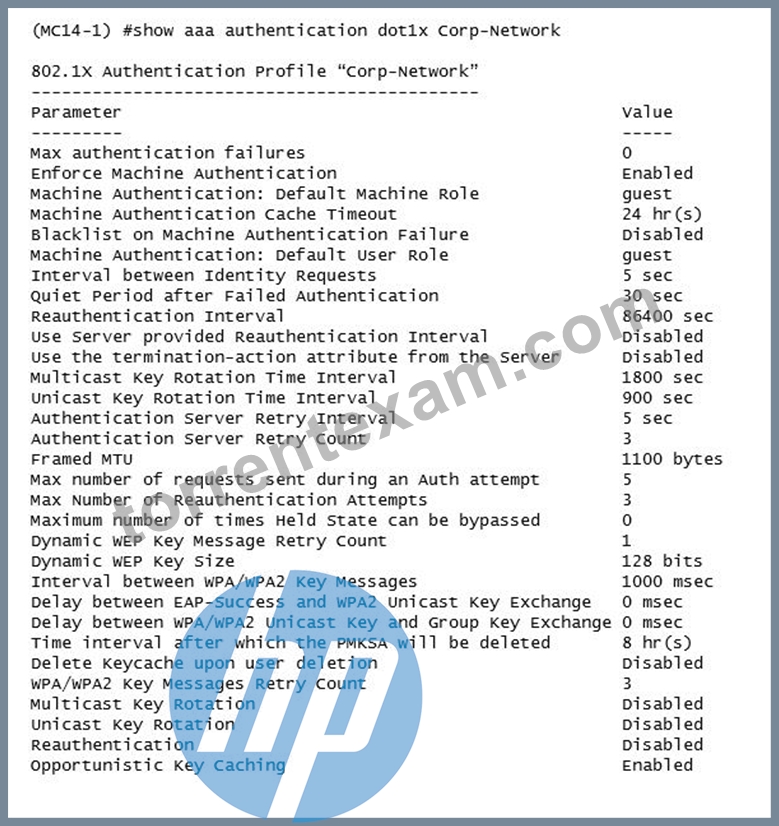
The network administrator must ensure that the configuration will force users to authenticate periodically every eight hours. Which configuration is required to effect this change?
- A. Set the reauth-period to 28800 enable reauthentication in both dotlx and AAA profile.
- B. Set the reauth-period to 28800 in the dotlx profile and enable reauthentication in the AAA profile.
- C. Set the reauth-period to 28800 enable reauthentication in the AAA profile.
- D. Set the reauth-period to 28800 enable reauthentication in the dotlx profile.
Answer: D
NEW QUESTION 28
A joint venture between two companies results in a fully functional WLAN Aruba solution. The network administrator uses the following script to integrate the WLAN solution with two radius servers, radius1 and radius2.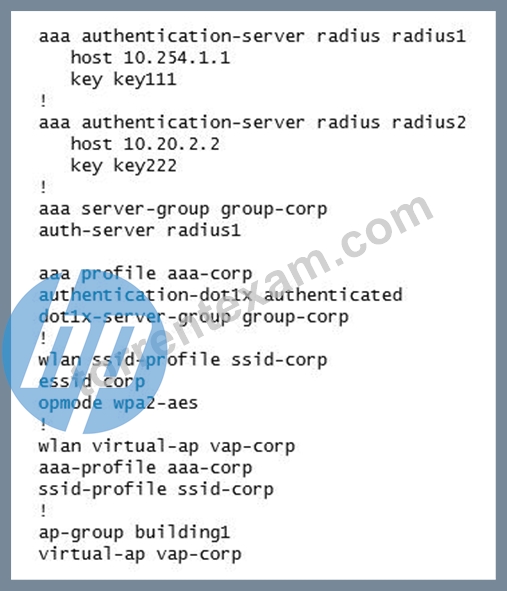
While all users authenticate with [email protected] type of credentials, radius1 has user accounts with the domain name portion.
Which additional configuration is required to authenticate corp1.com users with radius1 and corp2 users with radius2?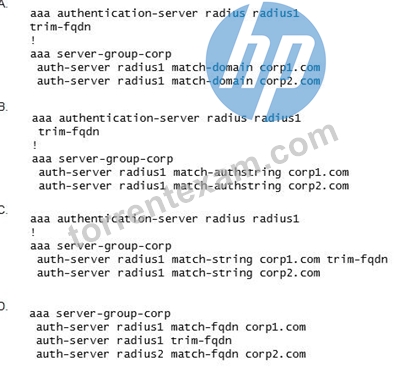
- A. Option D
- B. Option C
- C. Option B
- D. Option A
Answer: D
NEW QUESTION 29
Refer to the exhibit.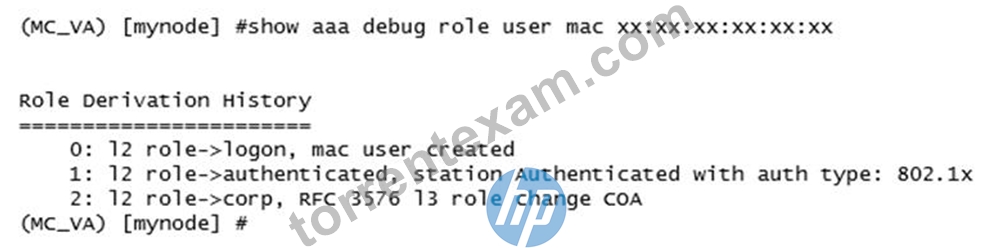
A network administrator has Mobility Master (MM) - Mobility Controller (MC) based network and has fully integrated the MCs with ClearPass for RADIUS-based AAA services. The administrator is testing different ways to run user role derivation.
Based on the show command output, what method has the administrator use for assigning the "corp" role to client with MAC xx:xx:xx:xx:xx:xx?
- A. Dynamic Authorization using VSA attributes.
- B. Server Derivation Rules using IETF attributes.
- C. User Derivation Rules using the client's MAC.
- D. Dynamic Authorization using IETF attributes.
Answer: A
NEW QUESTION 30
Refer to the exhibits.
Exhibit 1
Exhibit 2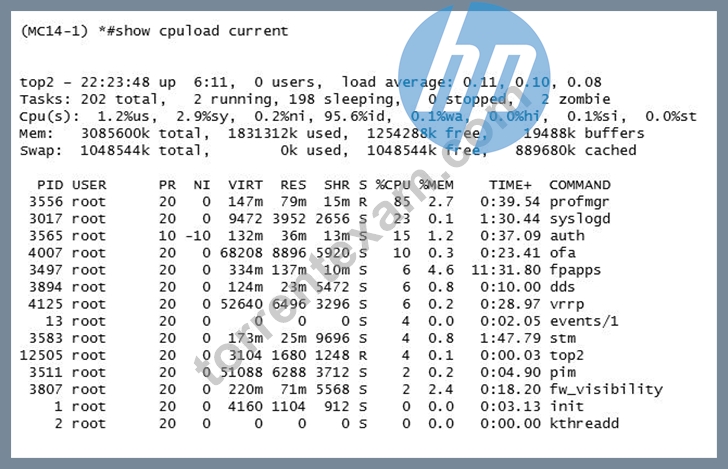
A network administrator adds a new Mobility Controller (MC) to the production Mobility Master (MM) and deploys APs that start broadcasting the employee SSID in the West wing of the building. Suddenly, the employees report client disconnects. When accessing the MM the network administrator notices that the MC is unreachable, then proceeds to access the MC's console and obtains the outputs shown in the exhibits.
What should the network administrator do next to solve the current problem?
- A. Verify the license pools in the MM.
- B. Open a TAC case and send the output of tar crash.
- C. Decommission the MC from the MM, and add it again.
- D. Kill two zombie processes then reboot the MC.
Answer: A
NEW QUESTION 31
A network administrator wants to receive a major alarm every time a controller or an Aruba switch goes down for either a local or an upstream device failure. Which alarm definition must the network administrator create to accomplish this?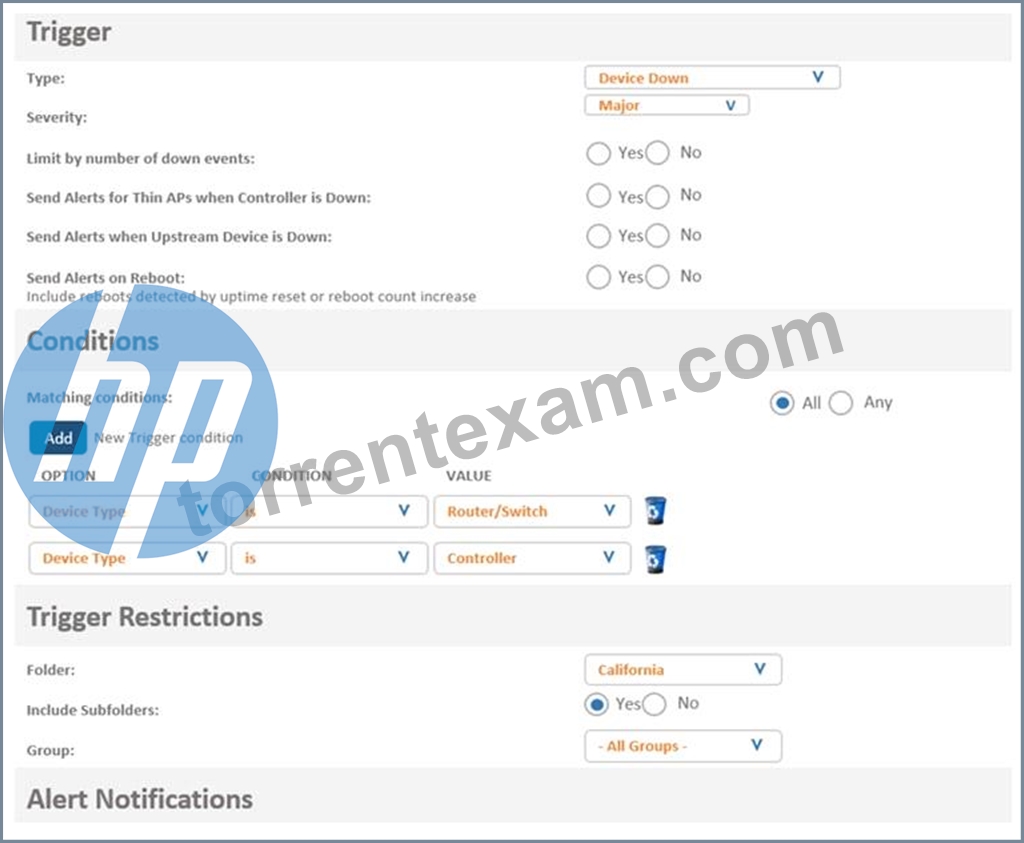
Answer:
Explanation: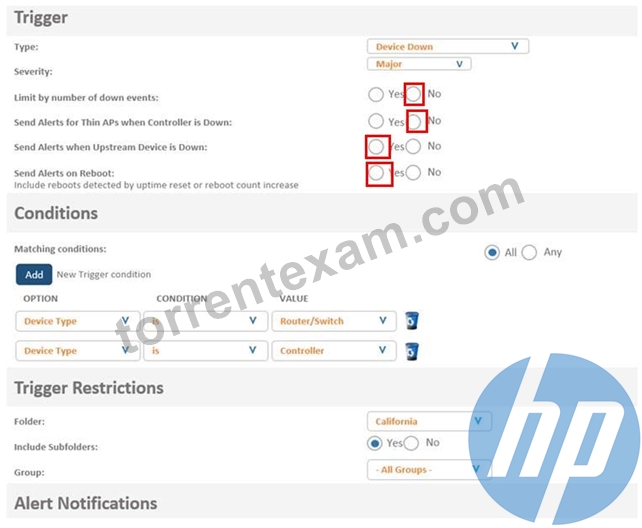
NEW QUESTION 32
Refer to the exhibit.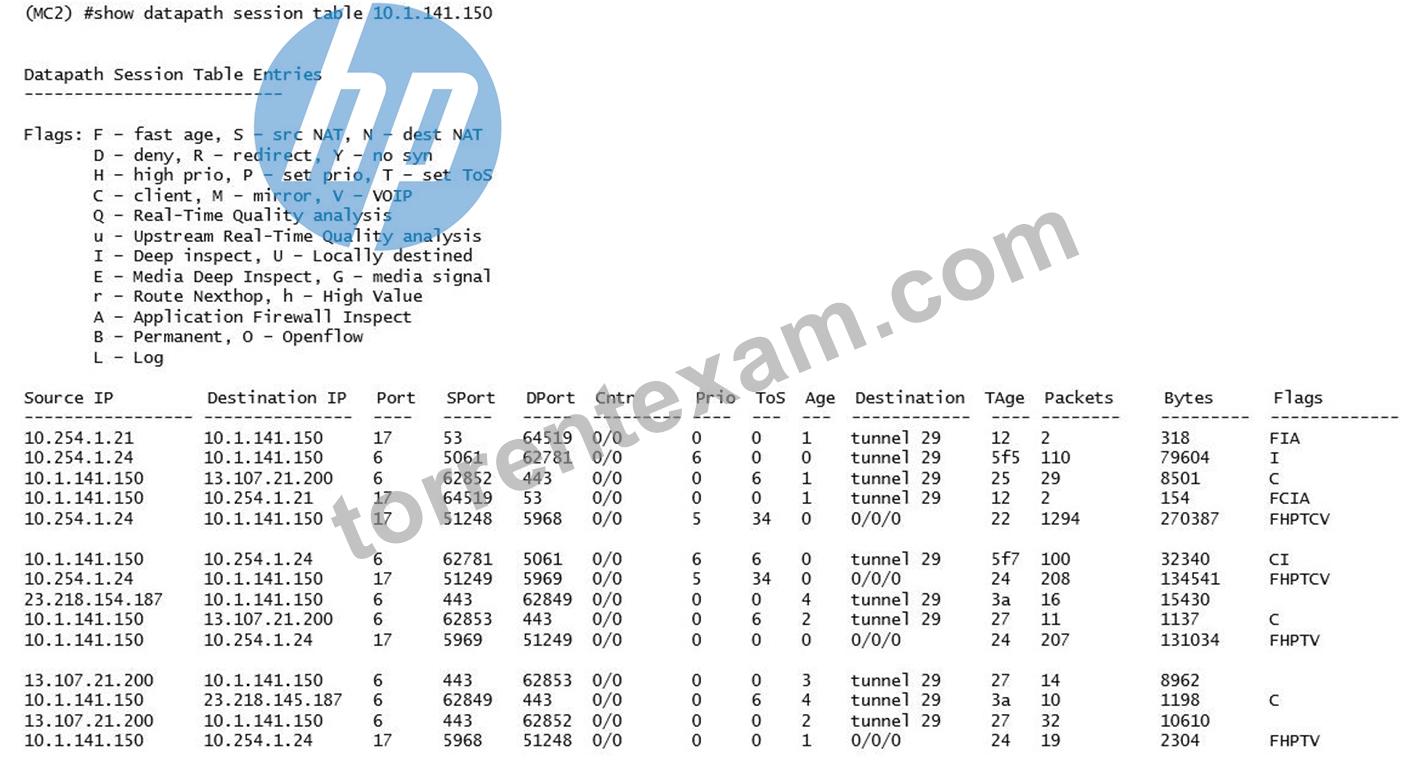
A network administrator deploys DSCP based prioritization in the entire wired network to improve voice quality for a SIP-based IP telephony system used by the company. However, users report that calls they make from WLAN have poor audio quality, while desktop phones do not experience the same problem. The network administrator makes a test call and looks in the datapath session table.
Based on the output shown in the exhibit, what is one area that the network administrator should focus on?
- A. UCC based DSCP correction
- B. wired network congestion
- C. WMM support on the WLAN
- D. Dynamic Multicast Rate Optimization
Answer: B
NEW QUESTION 33
A fully functional WLAN is deployed in a campus network using the following script.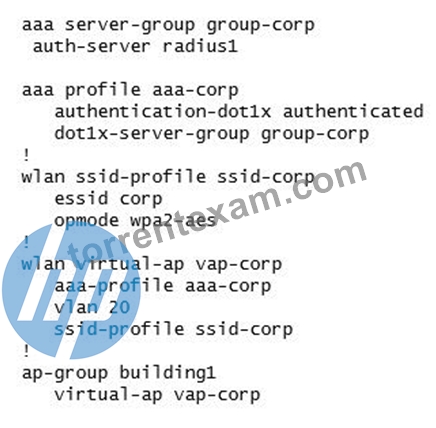
Which part of the script can a network administrator re-use to assign a different default role to users when they connect to the same SSID in a second building?
- A. server group and ssid profile
- B. server group and VAP
- C. server group, aaa profile, and ssid profile
- D. server group and VAP profile
Answer: A
NEW QUESTION 34
Refer to the exhibit.
A network administrator adds a Mobility Controller (MC) in the /mm level and notices that the device does not show up in the managed networks hierarchy. The network administrator accesses the CLI. executes the show switches command, and obtains the output shown in the exhibit.
What is the reason that the MC does not appear as a managed device in the hierarchy?
- A. The IP address of the MC does not match the one that was defined in the MM.
- B. The digital certificate of the MC is not trusted by the MM.
- C. The network administrator has not moved the device into a group yet.
- D. The network administrator added the device using the wrong Pre-Shared Key (PSK).
Answer: A
NEW QUESTION 35
Refer to the exhibit.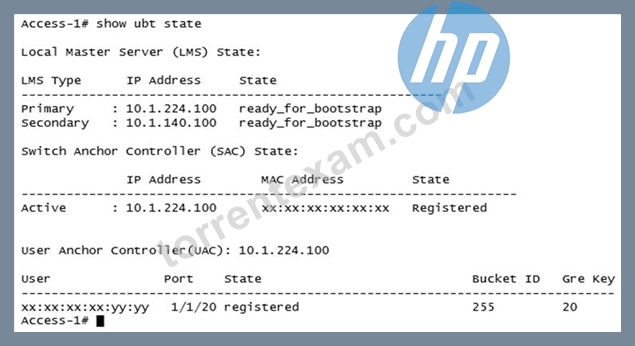
Based on the output shown in the exhibit, with which Aruba devices has Access-1 established tunnels?
- A. a pair of MCs within a L3 cluster
- B. a single standalone MC
- C. a pair of standalone MCs
- D. a pair of switches running VXLAN
Answer: A
NEW QUESTION 36
An organization has several RAPs at different locations that broadcast two SSIDs. The internet-only SSID is in bridge/always mode, and the corporate SSID is in split-tunneling/standard mode. The network administrator deploys 10 more RAPs in different locations.
Users can successfully connect to the corporate SSID that is propagated by a RAP at a remote location. However, they report that it takes too long to access public internet web sites.
What is one part of the configuration that should be checked by the network administrator to verify this RAP deployment?
- A. User roles policies
- B. Assigned VLAN
- C. Operating mode
- D. IP pool
Answer: A
NEW QUESTION 37
Refer to the exhibit.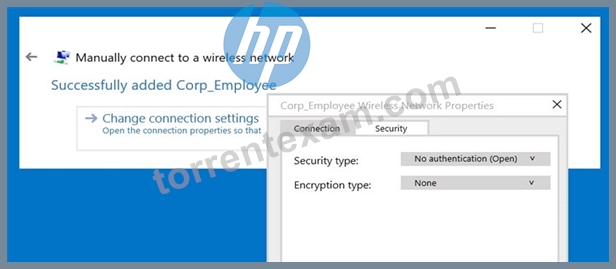
A network administrator wants to configure an 802.1x supplicant for a wireless network that includes the following:
* AES encryption
* EAP-MSCHAP v2-based user and machine authentication
* Validation of server certificate in Microsoft Windows 10
The network administrator creates a WLAN profile and selects the change connection settings option. Then the network administrator changes the security type to Microsoft: Protected EAP (PEAP), and enables user and machine authentication under Additional Settings.
What must the network administrator do next to accomplish the task?
- A. Enable server certificate validation under Settings.
- B. Change default RC4 encryption for AES.
- C. Change the security type to Microsoft: Smart Card or other certificate.
- D. Enable user authentication under Settings
Answer: C
NEW QUESTION 38
Refer to the exhibit.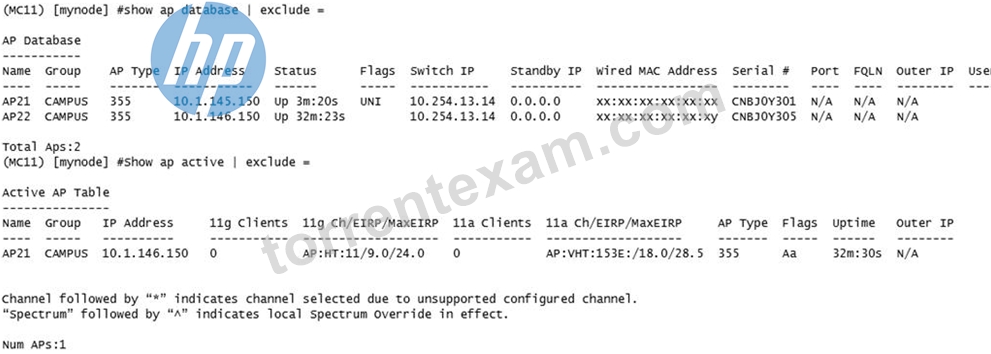
A network administrator deploys a new Mobility Master (MM) - Mobility Controller (MC) network. To test the solution, the network administrator accesses the console of a pair of APs and statically provisions them. However, one of the APs does not propagate the configured SSIDs. The network administrator looks at the logs and sees the output shown in the exhibit.
Which actions must the network administrator take to solve the problem?
- A. Re-provision the AP with a different group, and modify the name of one AP in the whitelist.
- B. Create another AP group in the MC's configuration, and re-provision one AP with a different group.
- C. Re-provision one of the APs with a different name or modify the name in the whitelist.
- D. Re-provision one of the APs with a different name, and add new entries with the proper group in the whitelist.
Answer: C
NEW QUESTION 39
Refer to the exhibits.
Exhibit 1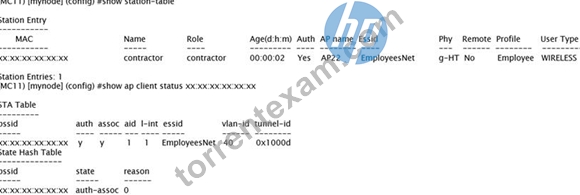
Exhibit 2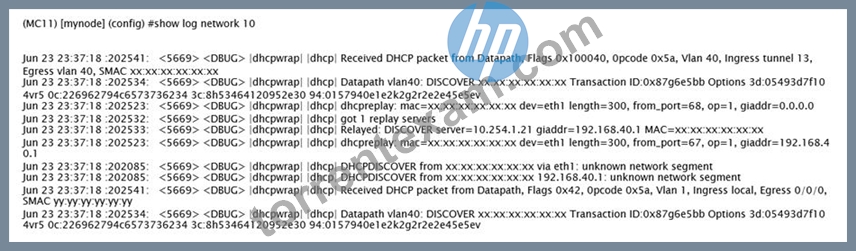
Exhibit 3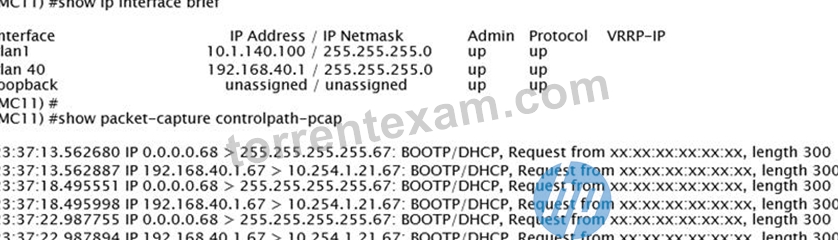
A network administrator wants to allow contractors to access the corporate WLAN named EmployeesNet with the contractor role in VLAN 40. When users connect, they do not seem to get an IP address. After some verification checks, the network administrator confirms the DHCP server (10.254.1.21) is reachable from the Mobility Controller (MC) and obtains the outputs shown in the exhibits.
What should the network administrator do next to troubleshoot this problem?
- A. Permit UDP67 to the contractor role.
- B. Confirm there is an IP pool for VLAN 40.
- C. Remove the IP address in VLAN 40.
- D. Configure the DHCP helper address.
Answer: A
NEW QUESTION 40
A network administrator has racked up a 7210 Mobility Controller (MC) that will be terminating 200+ Aps on a medium-size branch office. Next, the technician cabled the appliance with 4SPF+ Direct Attached Cables (DACs) distributed between two-member switching stack and powered it up.
What must the administrator do next in the MCs to assure maximum wired bandwidth utilization?
- A. Map the four physical ports to port channel 0.
- B. Disable spanning tree and allocate unique VLANs to each port.
- C. Manually set 10Gbps speeds on all ports.
- D. Configure the same MSTP region that the switches have.
- E. Make all ports trunk interfaces and permit data VLANs.
Answer: C
NEW QUESTION 41
Refer to the exhibit.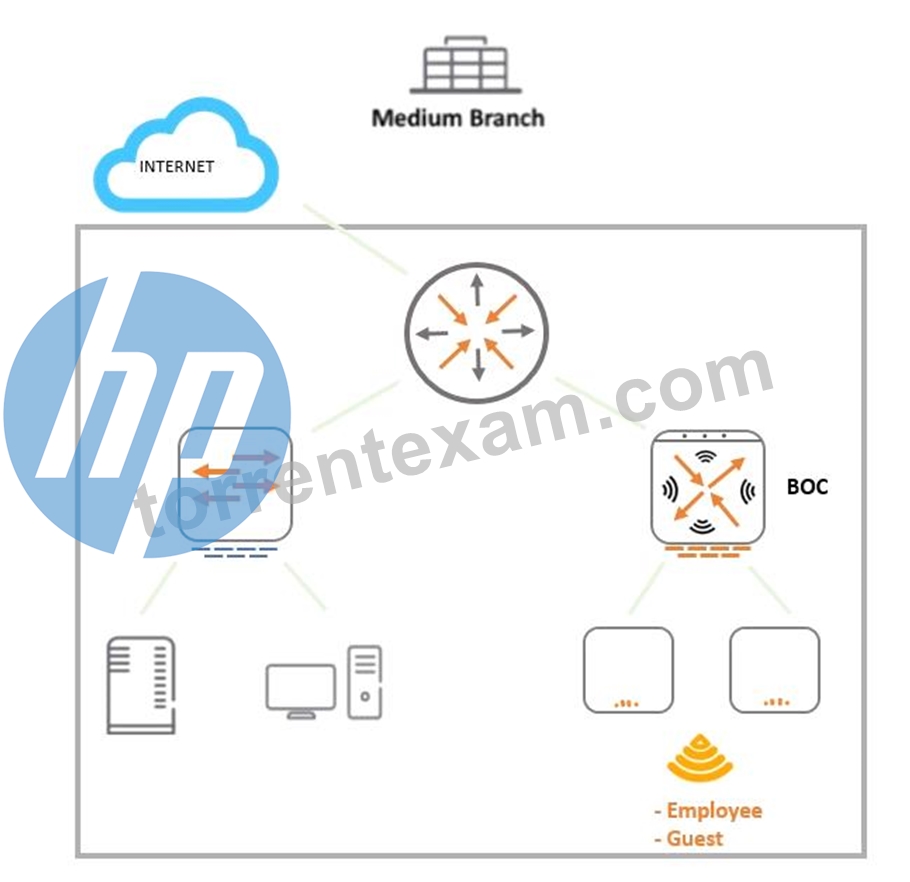
A 7008 Branch Office Controller (BOC) is deployed in a remote office behind a core router. This core does not support 802.1q encapsulation. The Mobility Controller (MC) is the gateway for two tunneling mode SSIDs, as shown in the exhibit.
Which two different configuration options ensure that wireless users are able to reach the branch network through the router? (Choose two.)
- A. Configure the uplink of the BOC as a trunk port, tagging the controller and the SSOD VLANs, and enable NAT for the SSID VLANs.
- B. Configure the uplink of the BOC as an access port on the controller VLAN, and enable NAT for the SSID VLANs.
- C. Configure all ports of the BOC as access ports on the controller VLAN, and change the gateway of clients to the core router IP.
- D. Configure the uplink of the BOC as an access port on the controller VLAN, and add static routes in the router for the SSID VLAN subnets.
- E. Configure the uplink of the BOC as a trunk port that permits the controller and the SSID VLANs. The controller VLAN must be native.
Answer: A,D
NEW QUESTION 42
......
HP HPE6-A79 Exam Syllabus Topics:
| Topic | Details |
|---|---|
| Topic 1 |
|
| Topic 2 |
|
| Topic 3 |
|
| Topic 4 |
|
| Topic 5 |
|
| Topic 6 |
|
| Topic 7 |
|
| Topic 8 |
|
| Topic 9 |
|
Exam Engine for HPE6-A79 Exam Free Demo & 365 Day Updates: https://www.torrentexam.com/HPE6-A79-exam-latest-torrent.html
HPE6-A79 PDF Questions and Testing Engine With 56 Questions: https://drive.google.com/open?id=1SKmdzSvSaxtPzG5V1TtN7XVf1Lz39bdg
