

Valid 4A0-106 Exam Q&A PDF 4A0-106 Dump is Ready (Updated 215 Questions)
Exam Questions and Answers for 4A0-106 Study Guide
NEW QUESTION 105
For a Carrier Supporting Carrier (CSC) VPRN where the customer carrier is an ISP that provides Internet connectivity to its end-customers, which of the following is FALSE?
- A. MPLS can be used in the customer carrier network to improve scalability.
- B. Customer carrier PE routers residing in different sites must run eBGP between them to exchange customers' routes.
- C. All traffic exchanged between end-customers is carried over a single CSC VRF.
- D. The customer carrier network can be a pure IP network.
Answer: B
Explanation:
Section: Volume A
NEW QUESTION 106
Which of the following statements best describes the output from an Nokia 7750 SR shown below?
- A. The BGP session between PEs is not operational
- B. The BGP session from PE to P is not operational
- C. The BGP session between PE and CE is not operational
- D. The BGP session from PE to CE is operational
- E. The BGP session between PEs is operational
Answer: D
NEW QUESTION 107
Which of the following statements is FALSE when providing Internet access using route leaking between a VRF and the global routing table?
- A. It is best used when a single VPN is required to provide Internet access, as well as to maintain VPN connectivity between different customer sites.
- B. The Nokia 7750 SR supports route leaking in full mesh and extranet VPRN topologies only.
- C. If there is no requirement for the VRF to contain the full Internet routing table, a default route to the Internet gateway router is sufficient.
- D. Only one interface on the CE is required for both VPN and Internet connectivity.
Answer: B
NEW QUESTION 108
Click the exhibit.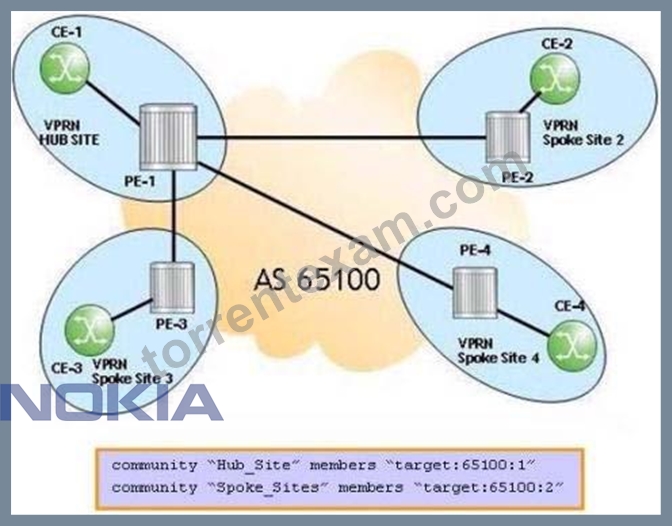
Community lists are configured for the PE hub and spoke VPRN. Which communities should be exported by the VPRN service on PE1?
- A. "Spoke_Sites"
- B. "Hub_Site"
- C. No communities should be exported
- D. "Spoke.Sites" and "Hub_Site"
Answer: B
NEW QUESTION 109
The policies shown below from the configuration of an Nokia 7750 SR have been created to implement an Extranet VPRN between the main sites of two separate VPRNs. How should these policies be applied?
- A. ample Policy should be applied as an export policy on both PEs connected to the main site of Customer 1 and the main site of Customer 2
- B. ample Policy 3 should be applied as an export policy on the PE connected to the main site of Customer 2
- C. ample Policy should be applied as an export policy on the PE connected to the main site of Customer 1
- D. ample Policy 3 should be applied as an export policy on both PEs connected to the main site of Customer 1 and the main site of Customer 2
- E. ample Policy should be applied as an export policy on all PEs connected to sites of Customer 1
Answer: C
NEW QUESTION 110
Which protocol is used to exchange customer VPRN routes between PE devices?
- A. ISIS
- B. Targeted LDP
- C. OSPF
- D. BGP
- E. MP-BGP
Answer: E
NEW QUESTION 111
Which of the following about Carrier Supporting Carrier (CSC) VPRN is FALSE?
- A. A CSC VPRN is configured on the customer carrier's CSC-CE routers.
- B. The customer carrier provides VPN or Internet services to its end-customers.
- C. CSC is also known as carrier's carrier or carrier serving carrier.
- D. CSC eliminates the need for customer carriers to build and maintain their own MPLS backbone.
Answer: A
NEW QUESTION 112
When configuring the CE with the selected CE-PE routing protocol on an Alcatel-Lucent 7750 SR, which of the following statements is true? (Choose three.)
- A. The protocol is configured under the config>service context
- B. The interface leading to the PE is defined as a protocol neighbor
- C. The protocol is configured under the global router context
- D. A routing policy may or may not be required depending on the routing requirements and routing protocol
- E. The routing protocol used must be the same as the routing protocol used at other CE-PE locations in the same VPN.
Answer: B,C,D
NEW QUESTION 113
Which of the following about the configuration of VPRN Outbound Route Filtering (ORB on an Nokia 7750 SR is TRUE?
- A. When sending is enabled, the ORF function takes the route target list configured in all outbound policies and pushes this list to the peer by default.
- B. When Outbound Route Filtering is configured, both the sending and acceptance of ORF are enabled by default.
- C. When configuring ORF, the session with the peer must be cleared/reset for the new capability negotiation to take place.
- D. The ORF configuration must be done under the BGP neighbor context only.
Answer: C
NEW QUESTION 114
Which command is required in the blank line to complete the configuration shown below on an Alcatel- Lucent 7750 SR?

- A. No shutdown
- B. Sap 1/1/1 customer 10 create
- C. Sap 1/1/1 create
- D. Neighbor 192.168.1.2
Answer: C
NEW QUESTION 115
Click the exhibit.
According to the display, a BGP loop is detected for route 192.168.1.0/27. On which router is this command executed?
- A. CE2
- B. CE1
- C. PE1
- D. PE2
Answer: A
Explanation:
Section: Volume A
Explanation
NEW QUESTION 116
Click the exhibit.
A Carrier Supporting Carrier (CSC) VPRN is configured on an Alcatel-Lucent 7750 SR for a customer carrier offering VPRN services. Which of the following about this configuration is FALSE?
- A. Configure an iBGP session between PE1 and PE2 and use the "family vpn-ipv4" CLI command to directly exchange end-customer routes learned from CE1 and CE2.
- B. In the CSC VPRN, configure an eBGP session between CSC-PE and CSC-CE and use the "advertise-label vpn-ipv4" CLI command to enable the advertisement of VPN-IPv4 routes.
- C. On the CSC-PE routers, use the "carrier-carrier-vpn" CLI command to configure the VPRN service as CSC.
- D. When the customer carrier uses the same autonomous system number in various sites, use the "loop- detect off" CLI command to disable the loop detection functionality on CSC-CE and PE routers.
Answer: B
Explanation:
Section: Volume A
Explanation
NEW QUESTION 117
Click the exhibit.
A Carrier Supporting Carrier (CSC) VPRN is configured for a customer carrier who is a BGP/MPLS service provider. If CE1 sends an IP packet to 192.168.200.1, which of the following is FALSE?
- A. PE1 pushes two labels on the IP packet: a BGP label and an LDP transport label.
- B. CSC-PE1 pops the BGP label and pushes a VPN label and an MPLS transport label.
- C. CE1 forwards the data packet to PE1 via the VPRN 20 interface.
- D. CSC-CE1 pops the LDP label and swaps the BGP label.
Answer: A
NEW QUESTION 118
Which of the following describes the goal of an Extranet VPRN?
- A. To reduce the number of VPRN tunnels required.
- B. To allow routes to be exchanged between all, or selected, sites of one VPRN, and all, or selected, sites of a second VPRN.
- C. To allow network access between the headquarter sites of each VPRN service and a shared VPRN service offered by a third party.
- D. To simplify the administration of multiple VPRNs.
Answer: B
NEW QUESTION 119
Which of the following statements about Inter-AS model B VPRN is TRUE?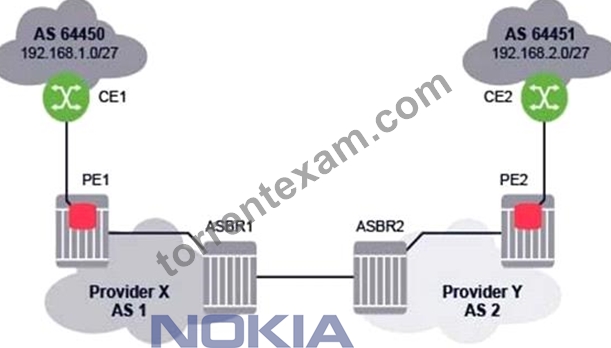
- A. MP-iBGP is used between PE1 and ASBR1 to exchange VPN-IPv4 routes.
- B. MP-eBGP is used between ASBR1 and ASBR2 to exchange labeled IPv4 routes.
- C. MP-eBGP is used between PE1 and PE2 to exchange VPN-IPv4 routes.
- D. eBGP is used between ASBR1 and ASBR2 to exchange IPv4 routes.
Answer: B
NEW QUESTION 120
In the output from an Alcatel-Lucent 7750 SR shown below, what does the highlighted text represent?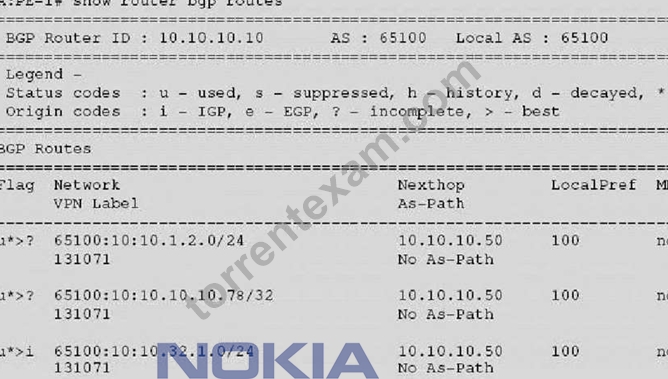
- A. The tunnel label
- B. The Service identifier
- C. The Route Distinguisher
- D. The LDP identifier
- E. The Route Target
Answer: C
NEW QUESTION 121
......
Certification dumps - Nokia Service Routing Architect 4A0-106 guides - 100% valid: https://www.torrentexam.com/4A0-106-exam-latest-torrent.html
