

Free Sales Ending Soon - 100% Valid 201 Exam Dumps with 255 Questions
Verified 201 dumps Q&As on your F5 Networks Certification Study Materials Exam Questions Certain Success!
Certification Path
F5 201 is the second exam. Successful completion by candidates will allow them to achieve F5 Certified! Administrator, BIG IP status.
NEW QUESTION 110
When using the setup utility to configure a redundant pair, you are asked to provide a "Failover Peer IP". Which address is this?
- A. an address on the current system used to listen for failover messages from the partner BIG-IP
- B. an address of the other system in a redundant pair configuration
- C. an address of the other system in its management network
- D. an address on the current system used to initiate mirroring and network failover heartbeat messages
Answer: B
NEW QUESTION 111
Refer to the exhibit.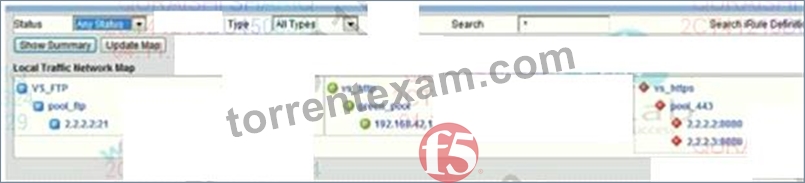
How many nodes are represented on the network map shown?
- A. Two
- B. One
- C. Four
- D. Three
Answer: D
NEW QUESTION 112
Which Virtual Server type prevents the use of a default pool?
- A. Standard
- B. Performance HTTP
- C. Forwarding (IP)
- D. Performance (Layer 4)
Answer: C
Explanation:
Explanation
Forwarding (IP) cannot be associated with the pool.
NEW QUESTION 113
The BIG-IP Administrator generates QKView using tmsh command "qkview -SO". In which directory does the BIG-IP appliance save the QKView?
- A. /var/tmp
- B. /var /tmp/qkview
- C. /etc/tmp
- D. /shared/qkview
Answer: A
NEW QUESTION 114
When configuring a pool member's monitor, which three association options are available. (Choose three.)
- A. inherit the pool's monitor
- B. assign a monitor to the specific member
- C. configure a default monitor
- D. inherit the node's monitor
- E. do not assign any monitor to the specific member
Answer: A,B,E
NEW QUESTION 115
A Virtual Server uses an iRule to send traffic to pool members depending on the URI. The BIG-IP Administrator needs to modify the pool member in the iRule.
Which event declaration does the BIG-IP Administrator need to change to accomplish this?
- A. CLIENT_ACCEPTED
- B. HTTP_RESPONSE
- C. SERVER_CONNECTED
- D. HTTP_REQUEST
Answer: D
Explanation:
Explanation
According to the UR! distribution is the category of HTTP requests, need to trigger HTTP_REQUEST event.
NEW QUESTION 116
Refer to the exhibit.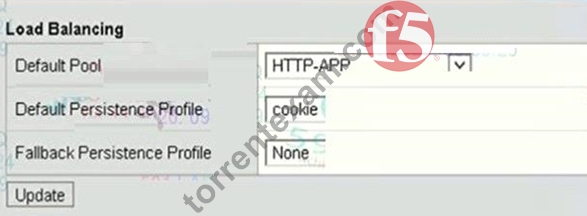
Due to a change in application requirements, a BIG-IP Administrator needs to modify the configuration of a Virtual Server to include a Fallback Persistence Profile.
Which persistence profile type should the BIG-IP Administrator use for this purpose?
- A. Source Address Affinity
- B. Hash
- C. Universal
- D. SSL
Answer: A
NEW QUESTION 117
Which statement describes a typical purpose of iRules?
- A. iRules can be used to add individual control characters to an HTTP data stream.
- B. iRules can be used to look at client requests and server responses to choose a pool member to select for load balancing
- C. iRules can examine a server response and remove it from a pool if the response is unexpected.
- D. iRules can be used to update the timers on monitors as a server load changes.
Answer: A
NEW QUESTION 118
Refer to the exhibit.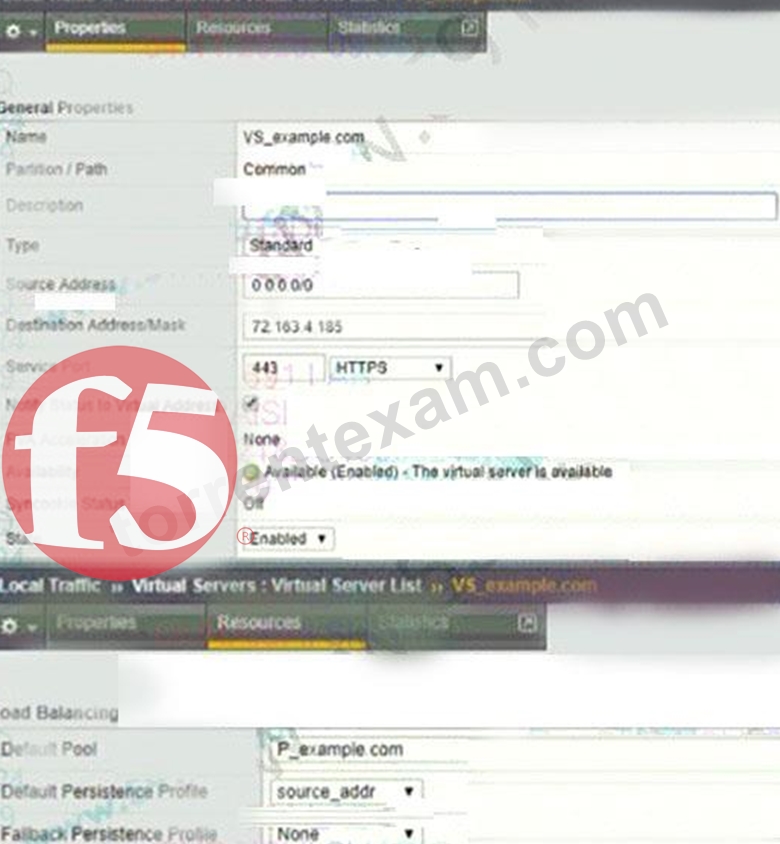
An organization is reporting slow performance accessing their Intranet website, hosted in a public cloud. All employees use a single Proxy Server with the public IP of 104.219.110.168 to connect to the Internet. What should the BIG-IP Administrator of the Intranet website do to fix this issue?
- A. Change Source Address to 104.219.110.168/32
- B. Change Fallback Persistence Profile to source_addr
- C. Change Load Balancing Method to Least Connection
- D. Change Default Persistence Profile to cookie
Answer: D
NEW QUESTION 119
When initially configuring the BIG-IP system using the config utility, which two parameters can be set? (Choose two.)
- A. the port lockdown settings for the host via the management port
- B. the netmask of the SCCP
- C. the IP address of the SCCP
- D. the port lockdown settings for the SCCP
- E. the IP address of the host via the management port
- F. the netmask of the host via the management port
Answer: E,F
NEW QUESTION 120
Refer to the exhibit.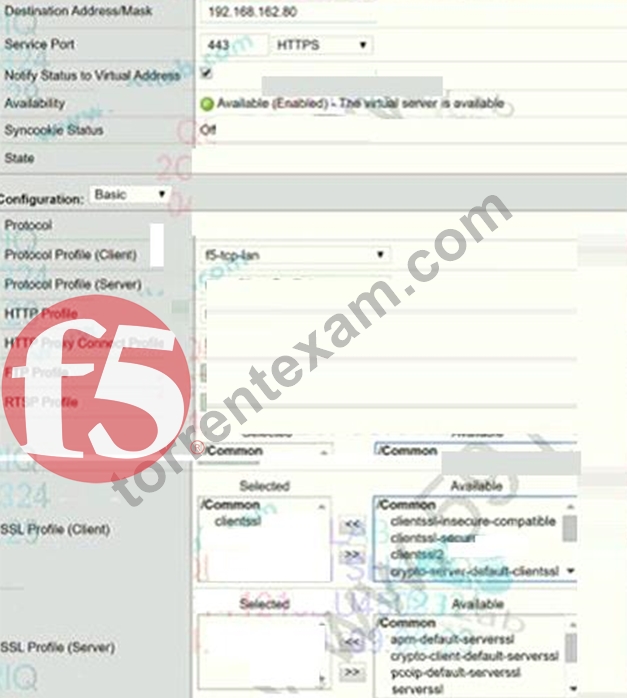
A BIG-IP Administrator needs to deploy an application on the BIG-IP system to perform SSL offload and re-encrypt the traffic to pool members.
During testing, users are unable to connect to the application.
What must the BIG-IP Administrator do to resolve the issue?
- A. Remove the configured SSL Profile (Client)
- B. Configure an SSL Profile (Server)
- C. Configure Protocol Profile (Server) as splitsession-default-tcp
- D. Enable Forward Proxy in the SSL Profile (Client)
Answer: B
Explanation:
According to the requirements of the subject, the client and server must be configured with ssl profile.
NEW QUESTION 121 
A BIG-IP Administrator notices that one of the servers that runs an application is NOT receiving any traffic.
The BIG-IP Administrator examines the configuration status of the application and observes the displayed monitor configuration and affected Pool Member status. What is the possible cause of this issue?
- A. The application is NOT responding with the expected Receive String.
- B. HTTP 1.1 is NOT appropriate for monitoring purposes.
- C. The Node Health Monitor is NOT responding.
- D. The BIG-IP device is NOT able to reach the Pool.
Answer: C
NEW QUESTION 122
For a given Virtual Server, the BIG-IP must perform SSL Offload and negotiate secure communication overTLSvl.2only.
What should the BIG-IP Administrator do to meet this requirement?
- A. Configure a custom SSL Profile (Server) and select no TLSvl in the options list
- B. Configure a custom SSL Profile (Client) with a custom TLSV1.2 cipher string
- C. Configure a custom SSL Profile (Server) with a custom TLSV1.2 cipher string
- D. Configure a custom SSL Profile (Client) and select no TLSvl in the options list
Answer: B
Explanation:
Explanation
no TLSvl only disables TLS1.0, TLS1.1 is still used and does not meet the requirements.
NEW QUESTION 123
Refer to the exhibit.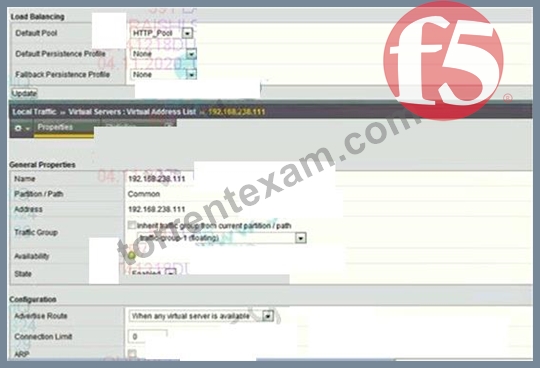
An LTM device has a virtual server mapped to www.f5.com. Users report that when they connect to
/resources/201.1.2h.l_l.com they are unable to receive content.
What is the likely cause of the issue?
- A. The virtual address does not have ARP enabled.
- B. The pool associated with the virtual server does not have priority group activation enabled.
- C. The pool associated with the virtual server is falling its health check.
- D. The virtual address does not have route advertising enabled.
Answer: A
NEW QUESTION 124
A BIG-IP Administrator makes a configuration change to a Virtual Server on the Standby device of an HA pair. The HA pair is currently configured with Auto-Sync Enabled. What effect will the change have on the HA pair configuration?
- A. The change will be undone next time a configuration change is made on the Active device.
- B. The change will be undone when Auto-Sync propagates the config to the HA pair.
- C. The change will take effect when Auto-Sync propagates the config to the HA pair.
- D. The change will be propagated next time a configuration change is made on the Active device.
Answer: C
NEW QUESTION 125
A BIG-IP Administrator opens a case with F5 Support. The support engineer requests the BIG-IP appliance chassis serial number.
Which TMSH command will provide this information?
- A. show /sys hardware
- B. list/sys diags
- C. . list /sys software
- D. show /sys version
Answer: A
NEW QUESTION 126
The incoming client IP address is 205.12.45.52. The last five connections have been sent to members C, D, A, B, B. Given the virtual server and pool definitions and the statistics shown in the graphic, which member will be used for the next connection?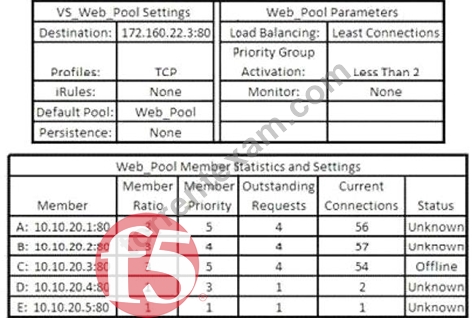
- A. 10.10.20.1:80
- B. 10.10.20.2:80
- C. 10.10.20.5:80
- D. 10.10.20.3:80
- E. 10.10.20.4:80
Answer: A
NEW QUESTION 127
A BIG-IP Administrator explicitly creates a traffic group on a BIG-IP device.
Which two types of configuration objects can be associated with this traffic group? (Choose two.)
- A. iRules
- B. Virtual Addresses
- C. Application Instances
- D. VLANS
- E. Pool Members
Answer: B,C
NEW QUESTION 128
When using the setup utility to configure a redundant pair, you are asked to provide a "Failover Peer IP". Which address is this.
- A. an address on the current
system used to
initiate mirroring
and network failElover heartbeat messages - B. an address of the other system in a redundant pair configuration
- C. an address of the other system in its management network
- D. an address on the current system used to listen for failElover messages from the partner BIGIP
Answer: B
NEW QUESTION 129
Which IP address will the client address be changed to when SNAT automap is specified within a Virtual Server configuration.
- A. The floating self IP address on the VLAN where the packet arrives on the system.
- B. It will alternate between the floating and noEl nfloating self IP address on the VLAN where the packet leaves the system so that port exhaustion is avoided.
- C. It will alternate between the floating and noElfnloating self IP address on the VLAN where the packet arrives on the system so that port exhaustion is avoided.
- D. The floating self IP address on the VLAN where the packet leaves the system.
Answer: D
NEW QUESTION 130
......
201 Exam Dumps - 100% Marks In 201 Exam: https://www.torrentexam.com/201-exam-latest-torrent.html
Exam Dumps Use Real F5 Networks Certification Study Materials Dumps With 255 Questions: https://drive.google.com/open?id=1YCUnkRKx0KatliwiyeHMIXiTru7UIuJC
