Booking the Associate-Developer-Apache-Spark-3.5 exam means paying the registration fee all over again if the first attempt goes wrong. That is why so many candidates rehearse with the Databricks Certified Associate Developer for Apache Spark 3.5 - Python questions from TorrentExam before they ever schedule a seat.
Databricks Associate-Developer-Apache-Spark-3.5 Exam Overview:
| Certification Vendor: | Databricks |
|---|---|
| Exam Name: | Databricks Certified Associate Developer for Apache Spark 3.5 - Python |
| Exam Number: | Associate-Developer-Apache-Spark-3.5-Python |
| Passing Score: | 70% |
| Exam Format: | Multiple select, Multiple choice |
| Exam Duration: | 90 minutes |
| Available Languages: | English |
| Exam Price: | $200 USD |
| Certificate Validity Period: | 2 years |
| Related Certifications: | Databricks Certified Data Engineer Associate Databricks Certified Data Engineer Professional |
| Real Exam Qty: | 45-60 |
| Recommended Training: | Databricks Academy - Apache Spark Training Apache Spark Documentation |
| Exam Registration: | Databricks Certification Portal |
| Sample Questions: |  |
| Exam Way: | Online proctored exam |
| Pre Condition: | Basic knowledge of Python programming and SQL is recommended. Familiarity with Apache Spark fundamentals is strongly suggested. |
| Official Syllabus URL: | https://www.databricks.com/learn/certification |
Databricks Associate-Developer-Apache-Spark-3.5 Exam Syllabus Topics:
| Section | Objectives |
|---|---|
| Topic 1: Data Ingestion and Storage | - Delta Lake basics - Reading and writing data (Parquet, JSON, CSV) |
| Topic 2: Structured Streaming Basics | - Streaming DataFrames - Windowed aggregations in streaming |
| Topic 3: Spark SQL | - Window functions and aggregations - SQL queries on DataFrames and tables |
| Topic 4: DataFrame API with PySpark | - Transformations and actions - DataFrame creation and schema management - Built-in functions and expressions |
| Topic 5: Data Processing and Performance | - Caching and persistence strategies - Optimization techniques - Joins and data partitioning |
| Topic 6: Apache Spark Fundamentals | - Spark architecture and execution model - RDD vs DataFrame vs Dataset concepts |
Associate-Developer-Apache-Spark-3.5 Exam FAQs: What Candidates Ask Before Booking
Registering for the Associate-Developer-Apache-Spark-3.5 exam costs $200 USD at the official rate, and you need 70% to pass. Bear in mind that an unsuccessful attempt is not discounted the second time around — a retake is charged at the full fee again. That is why experienced candidates test themselves with the 135 practice questions from TorrentExam until their results are consistently strong before spending money on the real thing.
Yes, and we encourage it. A free PDF demo of the Associate-Developer-Apache-Spark-3.5 questions is available so you can evaluate the quality and layout before buying. After purchase, your material stays current with 365 days of free updates — and if that period ever expires, you can extend the update service at a 50% discount through your member zone.
Registration is handled through the vendor's official channels:
As for how you will sit it, the Associate-Developer-Apache-Spark-3.5 exam is offered Online proctored exam — pick the option that fits your situation during booking.
You will face 45-60 questions within a time allowance of 90 minutes. Raw numbers aside, the real skill is pacing: candidates who run out of time usually spent too long on early questions. Our advice is to set a mental per-question budget, skip and revisit anything that stalls you, and complete at least two full timed runs in the TorrentExam test engine before the real appointment so the clock never rattles you.
Both situations are covered. Take the corresponding Associate-Developer-Apache-Spark-3.5 exam within 60 days of purchase without passing, and you may claim a full refund under our 100% Money Back Guarantee: submit a scanned exam enrollment slip plus the official Score Report PDF within 2 days of your exam date, and we finish processing within 7 days. The conditions are strict — an exam taken within 3 days of purchase does not qualify, the candidate's name must match the payer's, and free materials or expired orders are excluded. Would you rather keep studying? Swap the order for two other exam products of equal value free of charge while keeping updates on your original purchase. As for delivery, it is immediate: files unlock for download the moment payment clears, a copy reaches your mailbox within a minute, and there is no cap on how many computers you install it on — if 2 hours pass with nothing received, contact our support team.
Passing the Associate-Developer-Apache-Spark-3.5 exam earns you the Databricks Certified Associate Developer for Apache Spark 3.5 - Python certification, a Associate-level credential. It is the vendor's official proof that your skills meet the standard employers look for, and it regularly appears as a requirement in job postings. The certification also relates to Databricks Certified Data Engineer Associate, Databricks Certified Data Engineer Professional, so it can anchor a broader certification plan rather than stand alone.
Basic knowledge of Python programming and SQL is recommended. Familiarity with Apache Spark fundamentals is strongly suggested. Because vendors revise their eligibility rules from time to time, treat this as a starting point and verify the latest requirements on the official exam page — see the official Associate-Developer-Apache-Spark-3.5 exam outline before you commit to a test date.
The vendor organizes the Databricks Certified Associate Developer for Apache Spark 3.5 - Python blueprint into 6 domains, led by Data Ingestion and Storage, Structured Streaming Basics, Data Processing and Performance. Every domain contains further subtopics, and the weighting tells you where your study hours pay off most — the full outline above has the complete picture, so review it before building your study plan.
The vendor recommends the following official courses for this exam:
Training builds knowledge, but it does not measure readiness. Once you finish a course, put yourself to the test with the Associate-Developer-Apache-Spark-3.5 practice questions from TorrentExam — that is where you find out whether the material actually stuck.
Databricks Certified Associate Developer for Apache Spark 3.5 - Python Sample Questions:
A developer wants to test Spark Connect with an existing Spark application.
What are the two alternative ways the developer can start a local Spark Connect server without changing their existing application code? (Choose 2 answers)
- A. Ensure the Spark property spark.connect.grpc.binding.port is set to 15002 in the application code
- B. Add .remote("sc://localhost") to their SparkSession.builder calls in their Spark code
- C. Execute their pyspark shell with the option --remote "sc://localhost"
- D. Execute their pyspark shell with the option --remote "https://localhost"
- E. Set the environment variable SPARK_REMOTE="sc://localhost" before starting the pyspark shell
Correct Answer: C,E 🗳️
Explanation: Only visible for TorrentExam members. You can sign-up / login (it's free).
A developer is working with a pandas DataFrame containing user behavior data from a web application.
Which approach should be used for executing a groupBy operation in parallel across all workers in Apache Spark 3.5?
A)
Use the applylnPandas API
B)
C)
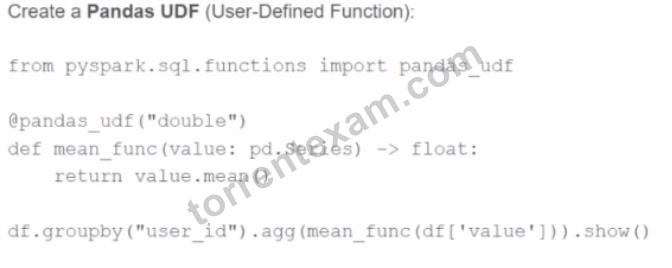
- A. Use a regular Spark UDF:
from pyspark.sql.functions import mean
df.groupBy("user_id").agg(mean("value")).show() - B. Use the mapInPandas API:
df.mapInPandas(mean_func, schema="user_id long, value double").show() - C. Use the applyInPandas API:
df.groupby("user_id").applyInPandas(mean_func, schema="user_id long, value double").show() - D. Use a Pandas UDF:
@pandas_udf("double")
def mean_func(value: pd.Series) -> float:
return value.mean()
df.groupby("user_id").agg(mean_func(df["value"])).show()
Correct Answer: C 🗳️
Explanation: Only visible for TorrentExam members. You can sign-up / login (it's free).
An engineer has two DataFrames: df1 (small) and df2 (large). A broadcast join is used:
python
CopyEdit
from pyspark.sql.functions import broadcast
result = df2.join(broadcast(df1), on='id', how='inner')
What is the purpose of using broadcast() in this scenario?
Options:
- A. It increases the partition size for df1 and df2.
- B. It reduces the number of shuffle operations by replicating the smaller DataFrame to all nodes.
- C. It filters the id values before performing the join.
- D. It ensures that the join happens only when the id values are identical.
Correct Answer: B 🗳️
Explanation: Only visible for TorrentExam members. You can sign-up / login (it's free).
Given a CSV file with the content:
And the following code:
from pyspark.sql.types import *
schema = StructType([
StructField("name", StringType()),
StructField("age", IntegerType())
])
spark.read.schema(schema).csv(path).collect()
What is the resulting output?
- A. The code throws an error due to a schema mismatch.
- B. [Row(name='bambi'), Row(name='alladin', age=20)]
- C. [Row(name='alladin', age=20)]
- D. [Row(name='bambi', age=None), Row(name='alladin', age=20)]
Correct Answer: D 🗳️
Explanation: Only visible for TorrentExam members. You can sign-up / login (it's free).
What is the difference between df.cache() and df.persist() in Spark DataFrame?
- A. persist() - Persists the DataFrame with the default storage level (MEMORY_AND_DISK_SER) and cache() - Can be used to set different storage levels to persist the contents of the DataFrame.
- B. Both functions perform the same operation. The persist() function provides improved performance as its default storage level is DISK_ONLY.
- C. Both cache() and persist() can be used to set the default storage level (MEMORY_AND_DISK_SER)
- D. cache() - Persists the DataFrame with the default storage level (MEMORY_AND_DISK) and persist() - Can be used to set different storage levels to persist the contents of the DataFrame
Correct Answer: D 🗳️
Explanation: Only visible for TorrentExam members. You can sign-up / login (it's free).
 Nigel
Nigel 
 Murray
 Stan
Stan  Christine
  Maurice
  Howar
Howar 
 Edmund
  Martina
  Honey
Honey  Andrew
  Alan
Alan  Buck
Buck  Donahue
  Fitzgerald
  Ives
Ives  Hazel
Hazel  Adolph